

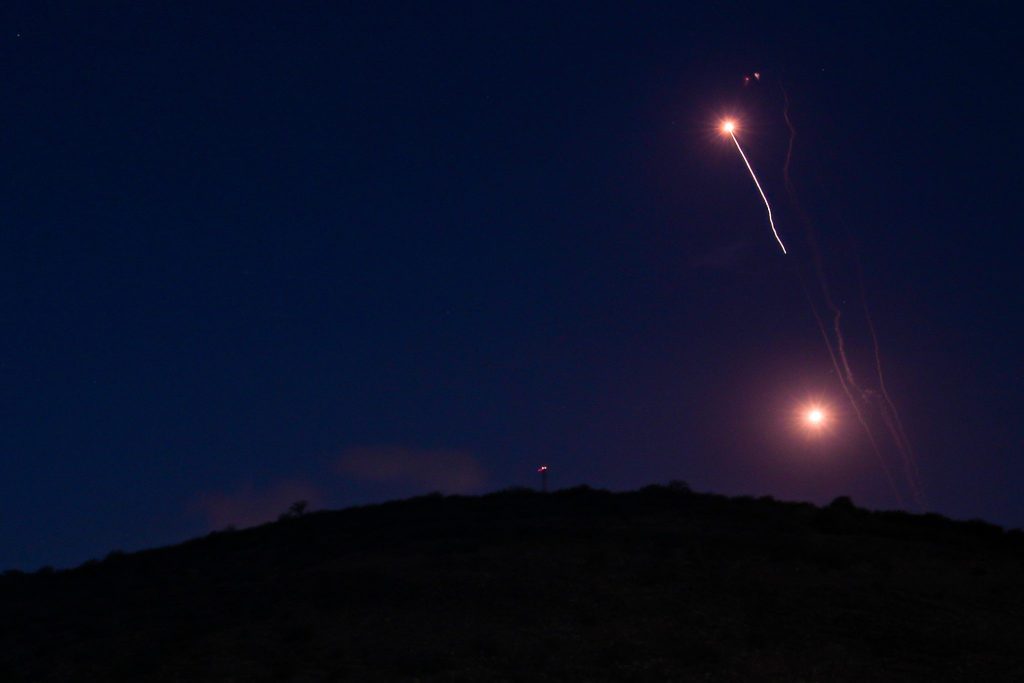
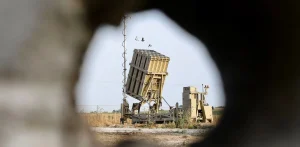
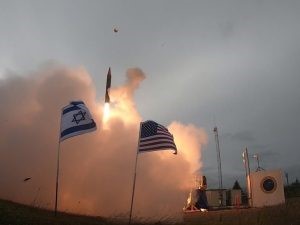
Israel currently operates three air defense systems: the Arrow for long-range ballistic missile interception, Iron Dome for short- and mid-range threats, and David’s Sling for various rocket threats. However, in the coming months, a fourth system will be added—laser interception, also designed for short- and mid-range threats.
Operational by End of 2025
In an interview on Nadav Perry’s podcast, Yuval Steinitz, Chairman of Rafael Advanced Defense Systems, revealed that the groundbreaking laser technology, “Iron Beam”, will enter operational use by the end of 2025.
Steinitz, a former minister, described the laser system as a technological breakthrough of historic and global significance. He emphasized that while world powers have spent 60 years attempting to develop laser weapons, none have succeeded in creating an effective system. He underlined the development by noting that, until now, there has been no fully functional laser weapon in the world. The best achieved so far is the ability to down slow-moving objects, such as drones and small boats, from a few hundred meters away.
Steinitz explained that the main obstacle to laser weaponry lies in its natural dispersion through the air. A laser is an extremely energetic beam of light, but it spreads out in the atmosphere. You can use it to cut steel or perform surgery—but only at a range of a few centimeters. In the air, it disperses gradually. After a few hundred meters, it becomes significantly weaker; after a kilometer, it almost fades away.
Challenges and Breakthroughs
Due to this limitation, sufficient energy does not reach the intended target. According to Steinitz, this was considered an insurmountable challenge. Air conditions, particularly temperature fluctuations, distort the laser. That’s why in the late 1990s and early 2000s, the IDF and the Ministry of Defense abandoned laser research and focused on developing the Iron Dome instead.
Rafael Did Not Give Up
Rafael, as a government-owned company with flexible research capabilities, continued investing in laser technology. A small team of three scientists and engineers worked relentlessly on the problem. About five years ago, they made a breakthrough. They developed a patent allowing the laser to ‘ignore’ air interference. Instead of firing a single powerful beam that disperses, multiple beams are fired —each at a slightly different frequency. These beams converge at the target point.
Essentially, Rafael’s scientists created a high-tech target range. Steinitz explained that the system identifies which laser beam is hitting the target most effectively and instantly adjusts all other beams to match its frequency. At lightning speed, all beams are recalibrated to act as a single, focused force. This process, known as ‘adaptive optics,’ allows air distortions to be minimized and concentrates maximum energy on the target, destroying it instantly. This process is repeated continuously to maintain a lethal and precise impact.
Interception Cost: Less Than $5
The laser system boasts two major advantages:
-
- Strengthening Israel’s Air Defense – The system will enhance interception capabilities and improve Israel’s ability to achieve 100% success rates.
- Dramatically Lower Costs – Currently, each Iron Dome interceptor costs about $100,000, while a single missile launched at Israel may cost only $10,000. This financial imbalance forces Israel to spend significantly more than the terrorist organizations it faces. Laser interception, however, costs only about $3–4 per shot, as the primary expense is electricity to charge the battery.
Rafael has already conducted advanced tests, successfully shooting down missiles and mortar shells within seconds. The laser will complement the Iron Dome system, with Steinitz predicting that most interceptions against rockets from Gaza and Lebanon will be handled by the new technology. Steinitz emphasized that the financial equation will be reversed, since with the integration of the Iron Beam, Israel’s enemies will face an almost unlimited defense system, at a negligible cost.