
128 years ago, the First World Zionist Congress was held in Basel, Switzerland, between August 29–31, 1897, the 1st–3rd of the Hebrew month of Elul 5657. It was the first large gathering of delegates of the Zionist movement. The event was initiated and led by Theodor Herzl, who became the central figure of political Zionism.
The Initiative for the Congress and Its Organization
The First Zionist Congress was born out of a wave of national awakening that swept the Jews of Eastern Europe following the ideas of Theodor Herzl. His book Der Judenstaat (“The Jewish State”) and his failure to enlist Jewish financiers pushed him to establish a political platform.
In March 1897, a “preparatory conference” was held in Vienna, where an organizing committee was elected. Herzl insisted on a public congress. At first, he planned to hold it in Zurich, but Russian representatives objected, fearing the congress would be linked to revolutionaries. Munich was then proposed, but rabbis and community leaders strongly opposed it. They feared that declaring “a Jewish nation seeking a homeland” would undermine the loyalty of German Jews to their state. Criticism even appeared in Munich newspapers. Herzl was forced to change course and chose Basel.
On the Shabbat before the congress opened, Herzl was called to the Torah in the synagogue and later wrote in his diary:
“Out of respect for religion I went on Shabbat… to the synagogue… When I ascended the bimah, I was more moved than during all the days of the congress. The few Hebrew words of the blessing choked my throat with emotion…”
The Course of the Congress – Opening Ceremony
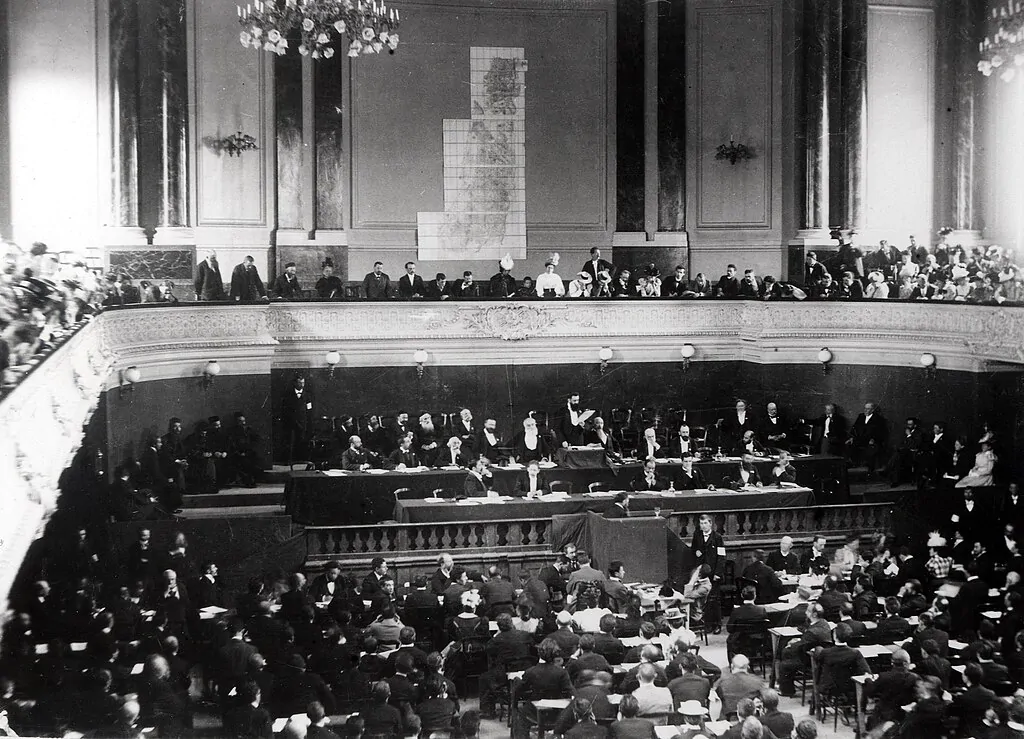
On August 29, 1897, the congress opened in the “Casino Hall.” Present were 208 delegates from 16 countries, dozens of journalists, and many excited onlookers – both Jews and Swiss non-Jews.
The event was opened by Karpel Lippe of Romania, the oldest delegate. He spoke three times longer than allotted, but moved the audience when he blessed: “Shehecheyanu, v’kiyimanu, v’higiyanu lazman hazeh.” At the end, he handed the chairman’s gavel to Herzl and declared: “The only thing we need is a homeland.”
When Herzl attempted to begin his speech, the hall erupted in nonstop applause lasting about fifteen minutes. Some even cried out, “Long live the king!” In his address, Herzl said: “We want to lay the foundation stone for the house that one day will shelter the Jewish people.” He emphasized that “Zionism is our return to Judaism even before our return to the Land of the Jews,” and he warned against unorganized infiltration into the Land: “There is no place in the world where the arrival of Jews will be watched more closely than in their historic homeland.”
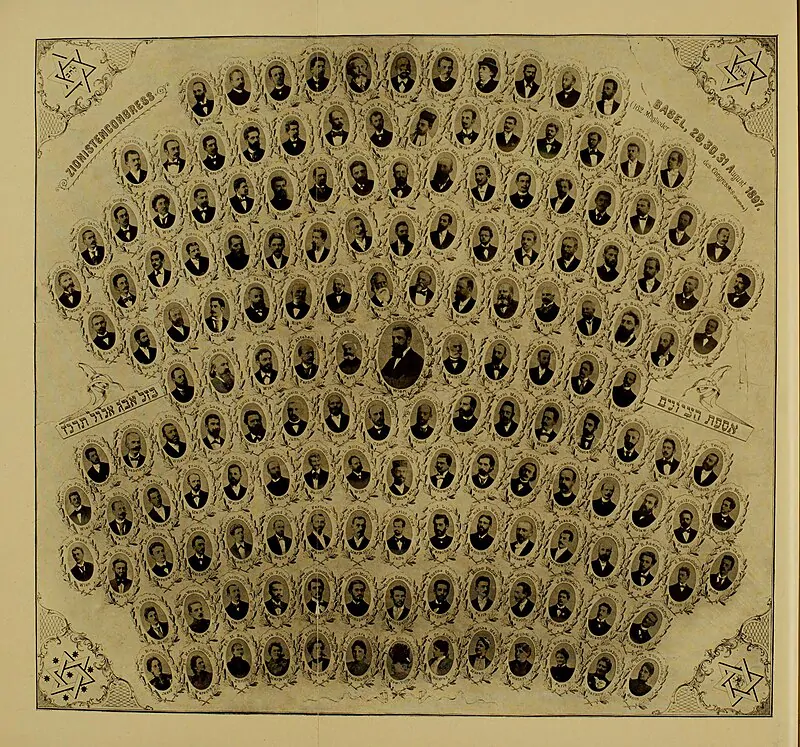
His words were again met with thunderous applause. The excitement in the hall was immense. Herzl was unanimously elected president of the congress. After him, Max Nordau spoke, describing the suffering of Jews around the world.
Congress Debates
The congress was divided into committees and held plenary discussions chaired by Herzl. On the third day, the main resolutions were adopted: a World Zionist Organization was established with an executive committee in Vienna under Herzl’s leadership; the “Zionist Shekel” was introduced – a voluntary tax of one franc per year; and a representative electoral system was set: one delegate for every hundred shekel-purchasers.
A sharp debate broke out between Hovevei Zion activists, who demanded immediate aliyah, and Herzl and his supporters, who first sought international guarantees. The compromise was the Basel Program: “The aim of Zionism is to create for the Jewish people a home in the Land of Israel secured by public law.” The wording, crafted by Max Nordau, was intentionally vague to avoid provoking opposition from the Ottoman Sultan.
Behind the scenes, Herzl reassured his confidant Jacob de Haas: “Do not worry. People will interpret this as if we had written ‘a Jewish state.’” Herzl was careful not to allow public statements that could endanger settlers in the Land of Israel or Jews in Russia. He knew that in the audience there were also czarist police agents and Ottoman informants.
At the conclusion of the deliberations, Herzl declared: “The First Zionist Congress is hereby closed.” His words were drowned in applause that lasted nearly an hour. Men stamped their feet, women waved handkerchiefs, delegates embraced and kissed. Others broke into singing and dancing on tables and chairs. From all sides came the cry: “Next year in Jerusalem!”
The Results of the Congress
The First Zionist Congress had immense historical significance. It placed the “Jewish question” on the international agenda and gave global resonance to the Zionist movement. For the first time, Jews from Eastern and Western Europe sat together, symbolizing national unity. In Basel, the goal was defined – a national home for the Jewish people in the Land of Israel.
At the same time, institutional foundations were laid: the Zionist Organization was established, an 18-member executive committee was elected, and a smaller five-member directorate headed by Herzl. The Zionist Shekel gave every participant the right to vote, thereby creating an organized infrastructure for the movement’s continuation.
The writer Israel Zangwill wrote:
“By the rivers of Babylon, there we sat, yea, we wept, when we remembered Zion. By the river of Basel we sat, and we resolved firmly never to weep again!”
Hayim Nahman Bialik dedicated a poem to the delegates:
“But even in the darkness, like an undying sun, your memory will remain with your scattered nation.”
And What Can We Learn?
Sometimes we do not notice, but a date can carry deep meaning, even without deliberate intent. The expulsion of Jews from Gush Katif in the Gaza Envelope was set for the day after Tisha B’Av, the day of the destruction of the Jewish Temple. And in contrast, although Herzl my have had no idea, choosing the 1st of Elul for the First Zionist Congress was profoundly symbolic.
Elul – the month of mercy and forgiveness and return to God; in that year, 5657, it shifted from a month of personal repentance to one of national return. A return that fifty years later became a state in the ancestral homeland.
And as Herzl summed up in his diary, a few days after returning to Vienna:
“If I were to sum up the Basel Congress in one phrase – which I must guard against speaking publicly – it would be this: in Basel I founded the Jewish State. If I said this aloud today, everyone would laugh at me. Perhaps in five years, and certainly in fifty, everyone will agree.”