

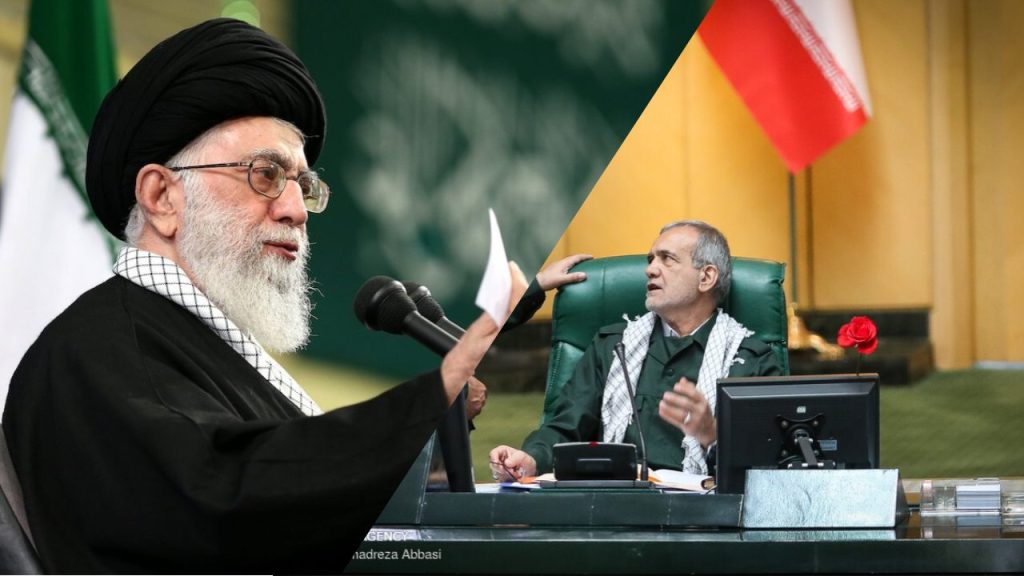
This morning (Sunday), American officials told the Politico website that Iran will “reconsider” the strength of the response, and that it is not expected to be “immediate.” This after another report published that the President of Iran, Masoud Pezeshkian, asked Supreme Leader Khamenei to reconsider the strength and directness of the Iranian response.
The reports come after a tense week, in which Israel was prepared for an Iranian attack that never happened, as part of a psychological mind game, as Hezbollah leader Nasrallah confessed last weekend. During the same week in which Iran released idle threats, it was exposed to tremendous pressure from all over the world, through diplomatic, economic and security channels, which might have led the president of the Islamic Republic to ask the supreme leader to rethink the attack.
The economic consideration
The main concern in Iran is an Israeli counterattack, which will probably avoid harming civilians directly, but would be forced to respond on the civilian level in the event that Iran attacks population centers in Israel, and is therefore expected to destroy the country’s strategic infrastructure, such as the wells, dams, ports, and even nuclear facilities. Such an injury would be devastating for tens of millions of citizens of the Islamic Republic, who are expected to suffer as a result of a fatal injury to the economic production capacity and relationship with the outside world.
The concern comes against the background of economic difficulties that Iran is already facing, among other things because of the sanctions that were imposed against it in an attempt to prevent their nuclear project.
עוד באותו הנושא
These sanctions were joined by the announcement of the President of the Council of the European Union, Charles Michel, after the attack on Israel in April, that the leaders of the Union decided to impose sanctions on Iran in the field of missile and UAV development.
The political consideration
According to a report published by Reuters last Tuesday, Russian President Putin asked Iran’s leader Khamenei that the response against Israel be “measured and softened,” and that the attack “would not result in injury to human life.” The unusual message was delivered in a face-to-face meeting of Sergiy Shoigu, Putin’s national security advisor, who came to Iran specifically for this purpose.
In addition to the Russian pressure, the United States is also exerting indirect pressure on Iran. Last week, the United States asked European countries and other allies to send a message to Iran, according to which “any significant attack will provoke a response” – according to a report by the Wall Street Journal. According to sources familiar with the details, “there will be a better chance for Iran to improve relations with the West” if the Iranian president acts with restraint. However, it was reported that the American message was rejected by Iran – as of last week.
The security consideration
As time passes, it becomes increasingly clear that Israel is not standing alone, and that the US military is expected to play a significant role in the counter-reaction, and crush Iran. They transfered F-22 fighter jets, which are not found in any other country in the world, to the region, alongside destroyers to intercept missiles.
Also, last week US Defense Secretary Lloyd Austin ordered the transfer of the aircraft carrier the Abraham Lincoln from the Indo-Pacific region to the Middle East, in addition to sending additional defense systems, as well as warships, vessels and an entire fighter squadron.
What might Iran do instead?
Instead of directly attacking Israel, and risking the destruction of its economy, international relations, and security infrastructure, Iran could send Hezbollah to do “the dirty work” in its place, and hijack the Israeli response accordingly. It is possible that sending the Shiite terrorist organization as its proxy force could be a sufficient answer for the Iranian need to respond to the assassination of the Hamas leader on its territory, while avoiding excessively destructive results.