
Exactly fifty years ago, on 31 May 1974, Israel and Syria signed the disengagement agreement that formally ended the Yom Kippur War on the northern front, along with the grueling war of attrition that followed. The agreement was born out of Israel’s desire for quiet along its northern border. It defined the boundary lines and military arrangements that remained officially in effect for five decades—until the fall of the Assad regime and the launch of Operation Arrow of Bashan on December 8, 2024.
Background to the Agreement
Following the Yom Kippur War, when the ceasefire came into effect on 21 October 1973, the IDF held not only the Israeli Golan Heights but also a salient within Syrian territory—some 400 square kilometers including dozens of villages, volcanic hills, and the summit of Mount Hermon. The tip of the Israeli advance came within 40 kilometers of Damascus.
However, quiet did not return to the border. The war of attrition persisted with thousands of skirmishes, daily shelling of IDF posts and civilian communities, and fierce fighting particularly over the Hermon ridge. Any delay in the diplomatic negotiations triggered renewed escalations. Talks began based on UN Security Council Resolution 339, but broke down early on: Syria demanded immediate withdrawal; Israel demanded a list of prisoners and Red Cross access.
Henry Kissinger, then U.S. Secretary of State, launched a whirlwind shuttle diplomacy effort. In February 1974, he secured a list of Israeli POWs in exchange for a promise to hand over the town of Quneitra to the Syrians—thus launching serious negotiations. Fighting continued in parallel, and the IDF kept its reserve forces mobilized as a pressure tactic against Syrian demands for further withdrawals.
In the end, Israel agreed to withdraw from the salient it had captured in Syria and from limited areas west of the “Purple Line” in the Golan. In return, a 235-square-kilometer buffer zone was established under the supervision of UNDOF, the UN Disengagement Observer Force. Negotiations were accompanied by misunderstandings that led to crises—and, at times, renewed hostilities. For example, while Israel agreed to hand over the city of Quneitra, Syria interpreted this as a concession of the entire Quneitra pocket, including Mount Avital and Mount Bental.
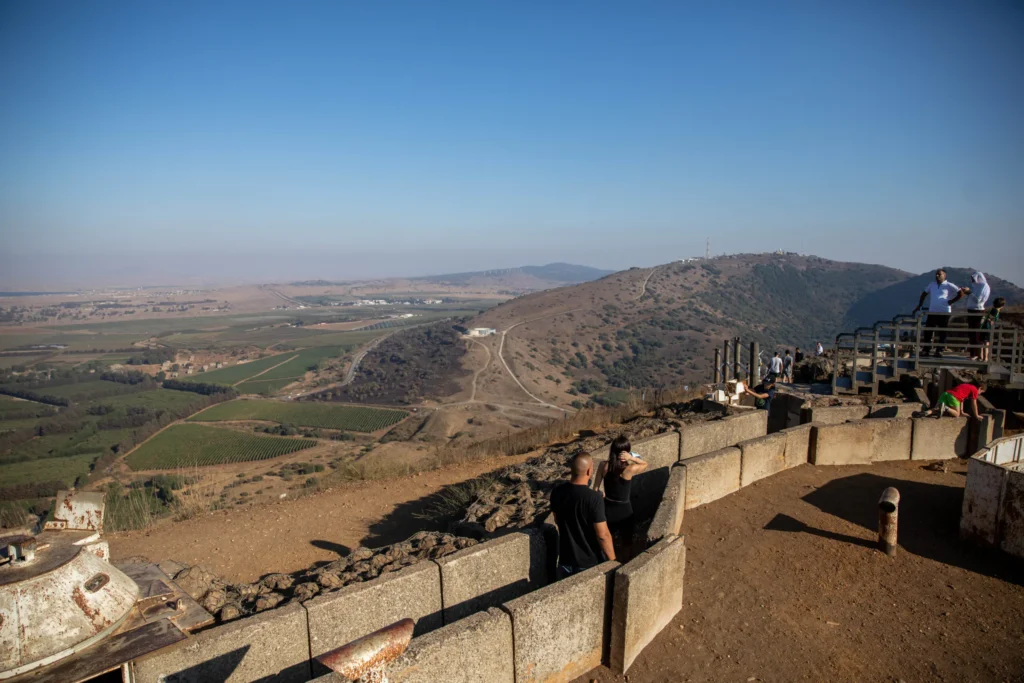
Main Elements of the Agreement: Boundary Lines, Buffer Zone, International Oversight
The agreement established an immediate ceasefire and the return of prisoners of war. Israel committed to withdraw from all territory captured in the Syrian salient in October 1973, including around Quneitra, and from several small pockets in the Golan.
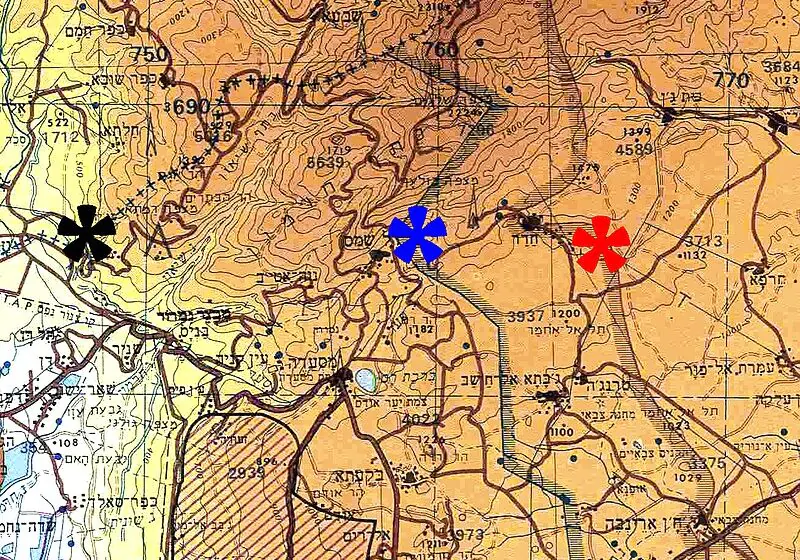
Two lines of separation were defined: a blue line for Israel and a red line for Syria, with a buffer zone between them—mostly on the Syrian side. Israel’s separation line closely matched the pre-war boundary, except for a few points in the southern Golan and around Quneitra, which were included in the buffer zone.
Watch IDF soldiers after the signing of the agreement:
Map of the Israel–Syria Boundary, 1974:
The buffer zone was designated a demilitarized area under UNDOF supervision. Each side was required to maintain a ten-kilometer zone of reduced military presence, with limits on troops and tanks, and a ban on deploying surface-to-air missiles within 25 kilometers of the front.
Syria verbally committed, via U.S. mediation, to prevent terror activity from the Golan sector and to resettle Quneitra.
From Prisoner Exchanges to Mount Hermon Withdrawal
On June 6, 1974, Israel and Syria completed the exchange of prisoners, including the return of fallen soldiers’ remains. The IDF withdrew from Mount Hermon and the salient in three phases, completing the handover by June 26, aligning with the new separation line.
Setting aside the terrorism that later emerged in Syria, the agreement held for nearly fifty years. The Golan Heights experienced relative—though largely imagined—quiet, even as IDF and Syrian forces clashed in Lebanon.
Syria did not always uphold its commitments: it established military positions in the buffer zone, restricted civilian access, and chose not to rebuild Quneitra. Instead, it built “New Quneitra” nearby and presented the ruins as evidence of “Israeli crimes.” Only in the 1980s were new towns like Baath constructed. Terrorist infiltrations were rare, mainly in the Mount Hermon area.
In December 2024, with the collapse of dictator Bashar al-Assad’s regime, Prime Minister Benjamin Netanyahu declared the agreement null. IDF tanks and infantry entered the demilitarized zone to prevent advances by rebel forces. On the same day, for the first time since the agreement, Israeli commandos seized abandoned Syrian positions on Mount Hermon—the same Hermon relinquished in October 1973.
Navy in Operation “Arrow of Bashan.” Watch:
What Can We Learn?
Israel is addicted to quiet—even when it’s an illusion. Agreements with Muslim states, whether short- or long-term, are eventually broken—sometimes within months, sometimes after decades. On the surface, there may be calm; beneath it, the reality is different. There, the effort to destroy Israel continues without pause.
The new Syrian president, Ahmed Hussein al-Sharaa—also known as Abu Mohammad al-Julani—was recently interviewed by the Jewish-American weekly Jewish Journal. In the issue published just over a week ago, he expressed willingness to begin dialogue with Jerusalem and stressed that the two nations “have common enemies.” His comments come amid reports of secret contacts between Jerusalem and Damascus aimed at reducing border tensions and avoiding direct conflict.
Israel welcomes this direction. But we must remember: al-Sharaa was, until recently, a senior jihadist in al-Qaeda. As such, he may deceive the world—presenting a moderate front to stabilize his rule, then turning Syria back into a terror state. He should be treated for what he is: a smiling terrorist in a suit. He must be kept weak—this is the correct approach when facing radical Islam.
Israel must change its mindset. We must internalize: this isn’t a sleepy European neighborhood—it’s a Middle Eastern jungle. Precisely because we value life, we must always be prepared for war—and, above all, act to prevent one.