
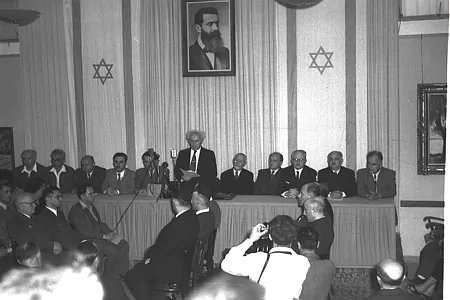
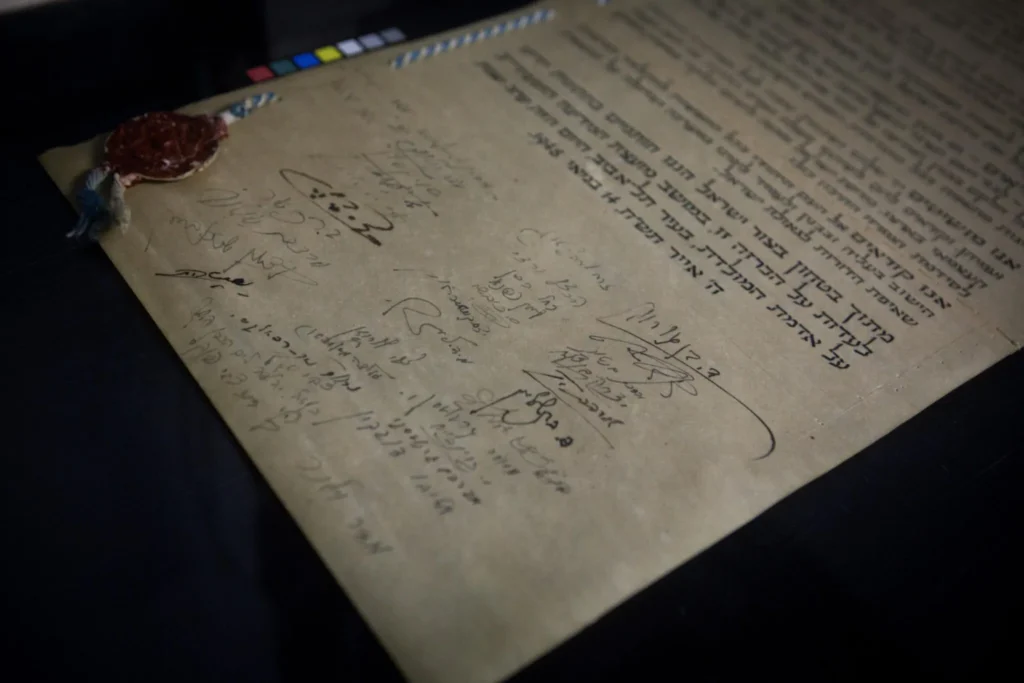
Seventy-seven years ago today, members of the People’s Council, led by David Ben-Gurion, declared the establishment of the State of Israel and signed the Declaration of Independence.
Four Parts to the Declaration
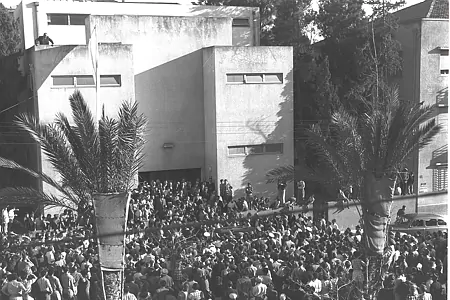
The declaration took place on Friday afternoon, the 5th of Iyar, 5708 (May 14, 1948), at the Tel Aviv Museum, then housed in the former Dizengoff residence.
The Declaration of Independence consists of four main sections: a historical account of the Jewish people, their struggle to restore national sovereignty, and international recognition of that right; the formal proclamation of the establishment of the State of Israel; a statement of the principles that would guide the new state; and an appeal to the United Nations, to the Arab residents of the land, to the neighboring Arab states, and to Jews in the Diaspora.
How Was the Declaration Drafted?
The text of the Declaration of Independence, as we know it today, only began to take shape three weeks before the actual declaration. The process was initiated by Pinchas Rosen—who would later become Israel’s first Minister of Justice—when he assigned the task to a young lawyer named Mordechai Beham.
Rosen instructed Beham to draft “a proclamation that opens with an account of the developments that led to the establishment of independent rule, and affirms that the Provisional Government Council has assumed the authority and responsibility to govern the country.”
Beham took the task seriously and began working on a first draft, but the process involved several versions and revisions. In writing such a foundational document, Beham drew inspiration from a variety of sources: the American Declaration of Independence, the Book of Deuteronomy, the English Bill of Rights (1689), and the UN General Assembly Resolution of November 29, 1947. He also added personal notes relating to specific points in those texts.
Other contributors to the draft included attorney Zvi Berenson, legal adviser to the Histadrut (General Federation of Labor), and Moshe Sharett, then a member of the People’s Administration, who would later serve as Israel’s first Foreign Minister and second Prime Minister. Ultimately, David Ben-Gurion approved the final version.
“Who has kept us alive, sustained us, and brought us to this time”
Preparations for the ceremony were made hastily and with great excitement. Around the head table sat the members of the People’s Administration and the secretary; opposite them were the members of the People’s Council. The invited guests were seated around them in a semicircle. Above them hung a portrait of Theodor Herzl.
At exactly four o’clock, David Ben-Gurion struck the table to begin the event. The audience spontaneously rose to its feet, and the singing of “Hatikvah” broke out. Ben-Gurion then began reading the Declaration of Independence.
When he finished, Rabbi Yehuda Leib HaCohen Maimon, a member of the People’s Council, came to the stage. In a trembling, emotional voice, he recited the blessing: “Who has kept us alive, sustained us, and brought us to this time.” The entire audience responded in unison: “Amen.”
The Second Phase of the War of Independence
Immediately following the declaration, a fierce military campaign erupted—known as the second phase of the War of Independence. It was fought between the forces of the newly established state and the invading Arab armies, who attacked from all directions. The fighters rose to the challenge, the Israel Defense Forces (IDF) was established, and the State of Israel secured its existence.
On the same day, Palestinians mark what they call “Nakba Day” (in Hebrew: Day of the Catastrophe). Sirens commemorating the Nakba were heard in Palestinian Arab villages in the Judea and Samaria region.