
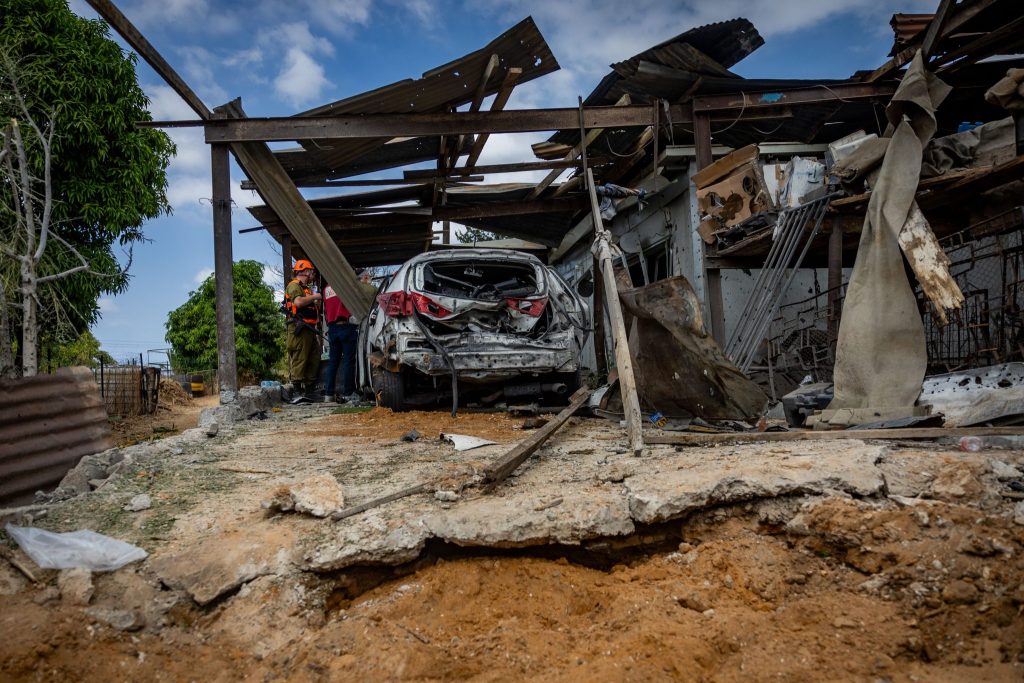
The operational investigation into the attack and battle at Kibbutz Kfar Aza was completed today (Monday), with its findings presented to the kibbutz community, bereaved families, the Rapid Response Team, and the widows of members who fell in combat. The investigation, led by IDF Chief of Staff Lt. Gen. Herzi Halevi, paints a complex picture of the events. While it highlights the failure of the IDF in defending the kibbutz, it also underscores the heroism, mutual responsibility, and resourcefulness demonstrated by the Rapid Response Team and kibbutz residents during the intense battle.
Security Forces Fought Bravely and Selflessly
The brutal attack on the kibbutz resulted in the murder of 62 residents and the abduction of 19 hostages to Gaza. Among them, two were mistakenly killed by Israeli forces during combat, and two remain in Hamas captivity as of today. The security forces that fought in the kibbutz displayed immense bravery and determination. During the battle, 31 members of the security forces were killed, and numerous soldiers and civilians were injured.
The Timeline of the Attack and Battle
Phase 1: Surprise Attack and Infiltration (05:30 – 08:30):
עוד באותו הנושא
- Selichot Season Opens with Spiritual Power and Unifying Prayer at the Western Wall
- With Hope and Resilience, Hostage Survivors Embrace Life After Captivity
- Israel Strengthens Global Alliances Amid Regional and International Challenges
- Beyond the Conventional: Haredi Soldiers and Wives of Warriors Stand with the IDF
- 05:30: IDF forces from the Northern Brigade of Gaza Division were deployed routinely as part of operation “Dawn Readiness.”
- 06:29: Hamas launched a heavy barrage at military positions and border defenses. Terrorists breached the security barrier at multiple points using vehicles, motorcycles, and paragliders.
- 06:43: Three terrorists landed inside Kfar Aza by paraglider. Meanwhile, a local defense company commander alerted troops about an incoming enemy force. A reconnaissance team was dispatched, but only part of it managed to reach the kibbutz.
- 06:54: Terrorists breached two gates of the kibbutz using explosives. Between 50 and 80 heavily armed terrorists stormed the community on trucks and motorcycles, initiating a massacre at multiple locations.
- By 08:30, an estimated 37 residents had been murdered, with terrorists continuing with abductions and attacks.
Phase 2: Massacre, Kidnappings, and Arrival of Security Forces (08:30 – 12:00)
- 08:33: The first small IDF force entered the kibbutz.
- 09:50: Senior commanders and additional security forces began arriving, but they faced difficult urban combat conditions, a lack of intelligence, and an unclear operational picture.
Phase 3: Halting the Enemy and Attempting to Stabilize the Situation (12:00 – 18:30)
- 12:30: A larger force of about 750 soldiers, led by the Givati Brigade commander, entered the kibbutz.
- Afternoon: The fighting concentrated in the northern section, with terrorists beginning to retreat or fortify positions.
Phase 4: Continuing Combat and Evacuating Civilians (18:30 – 08:00, October 8)
- Overnight: Forces engaged in close-quarters combat with remaining terrorists, setting ambushes to prevent reinforcements from Gaza.
Phase 5: Clearing the Kibbutz and Searching for Survivors (08:00 – 07:00, October 9)
- Troops conducted thorough searches to locate survivors and identify victims.
Phase 6: Ending Combat and Transitioning to Reserve Forces (07:00 – 20:00, October 9-10)
- The responsibility for securing the area shifted to reserve forces, while recovery efforts and security stabilization continued.
Phase 7: Recovering Victims and Final Sweep (October 10-11)
- The last terrorist in Kfar Aza was eliminated, and full control was restored to Israeli forces.
Key Findings of the Investigation
- The IDF failed to defend Kfar Aza, allowing terrorists to seize the community. Military forces did not arrive until 08:30 AM, leaving the Rapid Response Team and residents to battle dozens of heavily armed terrorists alone.
- Operational and strategic gaps were identified, including a lack of real-time situational awareness and inadequate defensive infrastructure.
- Security forces arrived in an uncoordinated manner, without clear leadership and often without proper combat gear, leading to chaotic engagements.
- By the afternoon of October 7, terrorists still controlled parts of the kibbutz, prolonging the massacre and kidnappings.
- Air force operations had minimal impact on the battle, despite targeted strikes.
- The bravery of the Rapid Response Team and kibbutz residents was instrumental in delaying the terrorists and saving lives.
- Civilian and wounded soldier evacuations were slow and lacked security, forcing units to conduct rescue missions under fire.
- The evacuation process was disorganized, relying on field commanders improvising without centralized coordination, leading to security gaps in rally points and extraction zones.
The investigation exposes severe failures in military preparedness and response but underscores the heroic resistance of civilians. The findings are expected to inform future security adjustments to prevent similar breaches in the future.