


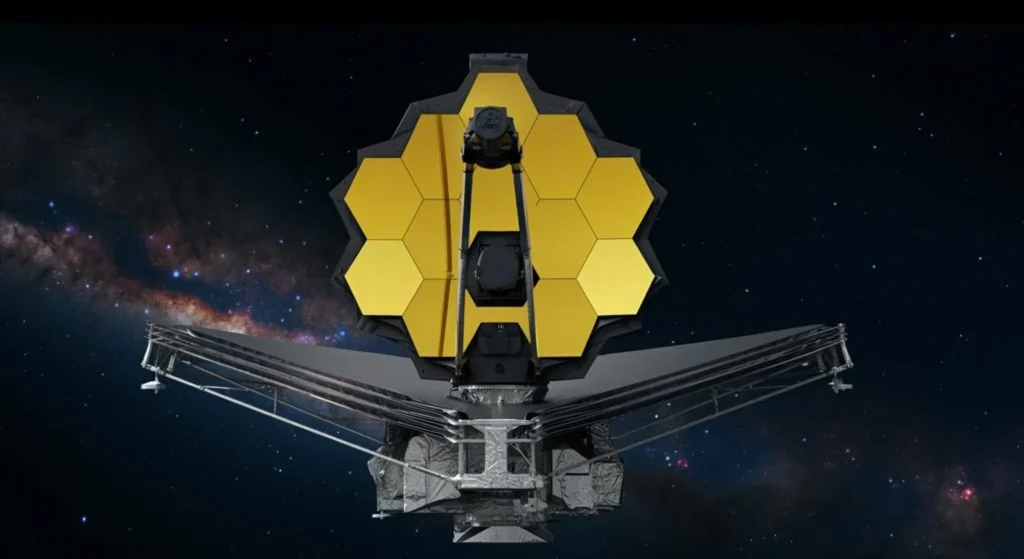
A team of scientists using the James Webb Space Telescope has detected what they describe as “the strongest evidence yet of life beyond our solar system,” according to a report Wednesday by Reuters.
A New Era in the Search for Life
In a groundbreaking observation, the team identified the chemical signatures of two gases—dimethyl sulfide (DMS) and dimethyl disulfide (DMDS)—in the atmosphere of an exoplanet known as K2-18 b. On Earth, these gases are produced only through biological activity.
These compounds, primarily emitted by microscopic organisms like marine plankton, suggest that life may exist on this distant planet, located approximately 124 light-years from Earth. However, the researchers emphasize that these are considered biosignatures—possible indicators of biological processes—not direct proof of living organisms.
Scientists from the University of Cambridge’s Centre for Astronomy and the Institute of Astronomy published their findings in the journal Astrophysical Journal Letters. The lead scientist, Prof. Nikku Madhusudhan, said the discovery marks “a transformative moment in the search for life beyond the solar system.” He described it as a new phase in the era of astrobiology.
The Exoplanet K2-18 b
K2-18 b is classified as a “Hycean world”—a type of exoplanet believed to be covered in a deep ocean and surrounded by a hydrogen-rich atmosphere. This environment could potentially support microbial life. The planet orbits within the habitable zone, where conditions may allow for the presence of liquid water—a key requirement for life as we know it.
It circles a small, cool red dwarf star and has a mass roughly 8.6 times that of Earth. Scientists believe that if life exists there, it could resemble the microbial life forms found in Earth’s oceans, such as plankton.
Proceeding with Caution
Despite the excitement, the scientists caution against drawing firm conclusions just yet. Prof. Madhusudhan stressed that additional observations are needed to confirm the findings. Further theoretical and experimental studies will also be required to explore whether the detected gases could have a non-biological origin.
The research team expects that the coming weeks will bring more data that could clarify the significance of the discovery and help determine whether the signals point to life—or to a different geochemical process.