
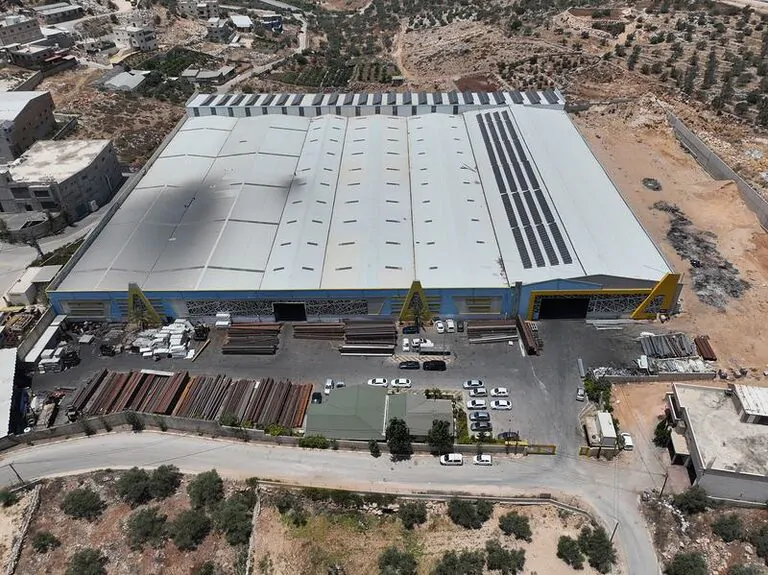
Today (Tuesday), the Regavim Movement submitted a petition to the District Court against a large-scale metal factory in Samaria. The facility was constructed illegally on state-surveyed land on the outskirts of the village of Biddya, near the security barrier. Covering an area of 30 dunams—about 21 of them built up—the factory operates without permits, in violation of regional construction laws.
A Giant Factory – Without Permits
According to information uncovered by Regavim, the factory is run by Mohammad Al-Amour, the Palestinian Authority’s Minister of National Economy and a wealthy businessman. Al-Amour has previously advocated for Palestinian business ventures as a path toward liberation from Israeli “occupation,” while simultaneously establishing this factory on state-designated land.
The facility produces prefabricated structures, containers, and construction materials, and is located less than 200 meters from the security fence—significantly increasing the threat to nearby Israeli infrastructure.
Lack of Enforcement
Regavim claims its efforts to contact enforcement officials in the Civil Administration have been ignored. Authorities have reportedly cited prioritization issues as the reason for inaction against the factory. According to the petition, the factory continues operating illegally, undermining the rule of law and creating a tangible security threat due to its proximity to Israel’s defense system.
A Call for Judicial Intervention
Regavim expressed frustration over the lack of enforcement, stating that this case exemplifies a growing trend of illegal construction in Area C.
“This is not just another small building—we’re talking about a massive factory that harms the fabric of life and endangers security,” the movement stated.
Despite repeated appeals and the legal petition, the factory remains operational, while local residents are calling on authorities to act decisively and bring the situation under control.