


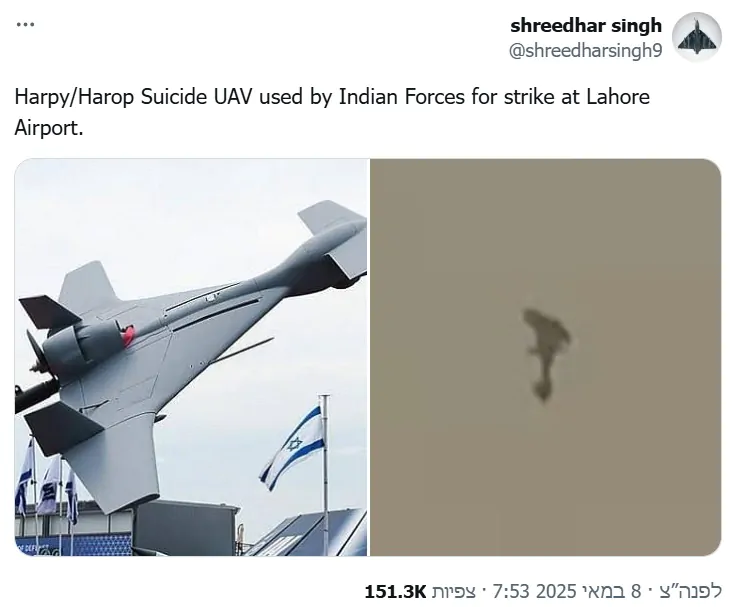
Dozens of unmanned aerial vehicles (UAVs) were launched from India toward targets in Pakistan, according to reports published Thursday by Pakistani media. Sirens were heard in several cities, including the capital, Islamabad. The attack was reportedly carried out using Israeli Harop drones, developed by Israel Aerospace Industries. Pakistan claimed to have intercepted and shot down at least 25 of these drones.
Footage of one of the UAVs. WATCH:
#BREAKING Pakistan says India attacked it with Israeli-made suicide drones pic.twitter.com/XH443hYt1y
— Guy Elster גיא אלסטר (@guyelster) May 8, 2025
Kashmir Once Again Sparks Fighting Between the Nations
Earlier in the day, the Pakistani military announced it had intercepted 25 Israeli-made UAVs launched from Indian territory to strike targets inside Pakistan. Videos released from within Pakistan appeared to show several UAV strikes across the country. In Lahore, the country’s second-largest city with approximately 11 million residents, one drone reportedly hit a Pakistani military facility, injuring several soldiers. The Indian military stated it had targeted locations connected to Pakistan’s air defense infrastructure. In another incident, an Indian drone was intercepted en route to the capital.
The current escalation began last month when a terrorist cell operating from Pakistan infiltrated Indian-administered Kashmir—an area long at the heart of hostilities between the two countries. The terrorists carried out a deadly attack in the Baisaran Valley near the town of Pahalgam, killing 26 people and injuring about 20 others. On Tuesday of this week, India launched ballistic missile strikes on several targets in Pakistan in response to the attack. Indian authorities held Pakistan’s government responsible for the incident.
“The selected targets were destroyed with precision according to a planned strategy”
On Tuesday night, India struck nine targets in Pakistan using ballistic missiles, in retaliation for the terror attack in Kashmir last month. Pakistan reported 31 dead and 46 wounded. Prime Minister Shehbaz Sharif of Pakistan threatened that his country would respond “at a time, place, and manner of our choosing.”
He added, “India’s strike last night was a grave mistake. It will pay the price.” India maintained that the targets were selected carefully and struck with precision. Indian Defense Minister Rajnath Singh emphasized, “The selected targets were destroyed with precision according to a planned strategy,” adding that India had taken steps to avoid harming civilians.
Following the strike, a massive aerial confrontation broke out between the two nations. A senior Pakistani official told CNN that 125 fighter jets took part in the engagement—if confirmed, it would be the largest air battle of the modern era. Pakistani defense sources claimed to have shot down five Indian aircraft, including three French-made Rafale jets acquired by India in recent years. A senior French intelligence official told CNN that one Rafale had indeed been downed, and French authorities were investigating whether additional aircraft were lost. As of this writing, India has not commented beyond confirming that “five aircraft crashed.”
Carries a 16-Kilogram Warhead
The Harop UAV was developed by Israel Aerospace Industries and has been sold to India and other countries, including Azerbaijan, which used it extensively in the 2020 Nagorno-Karabakh War. The Harop is a loitering munition, also known as a suicide drone. It can remain airborne for up to nine hours and has an operational range of 200 kilometers. It carries a 16-kg warhead and can perform precision strikes from multiple angles using electro-optical and infrared sensors. Manufactured by IAI’s MALAM division, the drone can be operated remotely or autonomously and can return to base if no target is found. It is designed to strike high-value targets such as command centers and missile launchers.