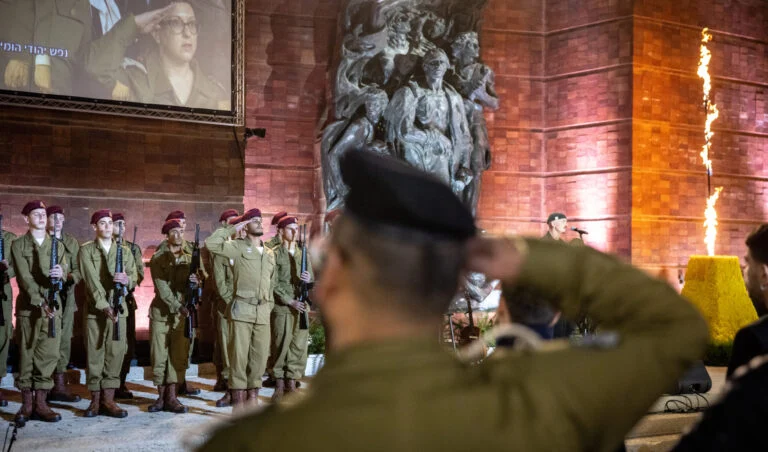
The eve of Holocaust Remembrance Day will open with the official state ceremony at Warsaw Ghetto Square in the Yad Vashem museum on Wednesday, April 23 (25 Nisan), at 20:00. Speeches will be delivered by President Isaac Herzog and Prime Minister Benjamin Netanyahu. Yad Vashem Chairman Dani Dayan will light the memorial flame. The “El Maleh Rachamim” prayer will be recited by survivor Yehuda Hauptman. This year’s theme commemorates 80 years since the defeat of Nazi Germany: “From the Depths – The Pain of Liberation and the Strength to Rebuild.”
“In early May 1945, Nazi Germany signed an unconditional surrender to the Allied forces. The European front of World War II came to an end, though fighting would continue for several more months in the Far East. On the scorched ruins of Berlin, Allied soldiers met, and around the world – and across the continent newly freed from Nazi rule – military parades and public celebrations took place.
But one nation did not join in the celebrations: our people, the Jewish people. For us, victory came too late. The day of liberation that Jews had longed for during the Holocaust was often one of heartbreak and emptiness. A deep sense of isolation. By that May, with Nazi Germany defeated, it became clear that six million Jews had been murdered—one-third of the entire Jewish people.”
Six Torches
During the ceremony, six Holocaust survivors will light memorial torches: Arie Durst, Monika Berzel, Felix Surin, Rachel Katz, Aryeh Reiter, and Gad Partok. The survivor’s address will be delivered by Eva Erban.
First Torch: Arie Durst, 92
Arie Durst was born in 1933 in Lviv, Ukraine (then Poland). His brother Marian was born in 1939, the year the Soviet Union occupied the city.
In June 1941, Nazi Germany invaded the Soviet Union and captured Lviv. Arie’s father, Friedrich, was conscripted as a physician into the Red Army. During the German Aktionen (raids), Arie and his mother hid in the basement of his former nanny, a non-Jewish woman.
In one Aktion, Arie’s brother Marian was murdered, along with the rest of his family. Arie’s mother, Salomea, obtained forged documents and planned to escape to Warsaw. She hired a Polish escort to accompany her and Arie to avoid suspicion. In Warsaw, she rented a room from a French widow, telling others they were Catholic Poles. Arie was raised as a Catholic, taken to church on Sundays, and taught Christian practices by their landlady.
One day, police arrived at their building. The doorkeeper delayed them long enough for Arie and his mother to escape. That day, August 1, 1944, the Warsaw Uprising began. Arie and his mother went into hiding, but about a month later, they were caught and deported by train toward the Pruszków labor camp. They escaped to the town of Leszno Góra, where Arie worked as a peddler until liberation.
After the war, they located Arie’s father, who had reached Tel Aviv, and in 1945 the family reunited in Eretz Israel, thanks to immigration certificates he had secured. Arie studied in the military medical track, served as a physician in the Golani Brigade, and was awarded a commendation from the regional commander for performing emergency surgery under fire. He founded Israel’s first transplant unit, directed the surgical division at Hadassah Hospital, and introduced innovations in surgery and care for oncology and trauma patients.
Arie and his wife Ramona have three children and eight grandchildren.
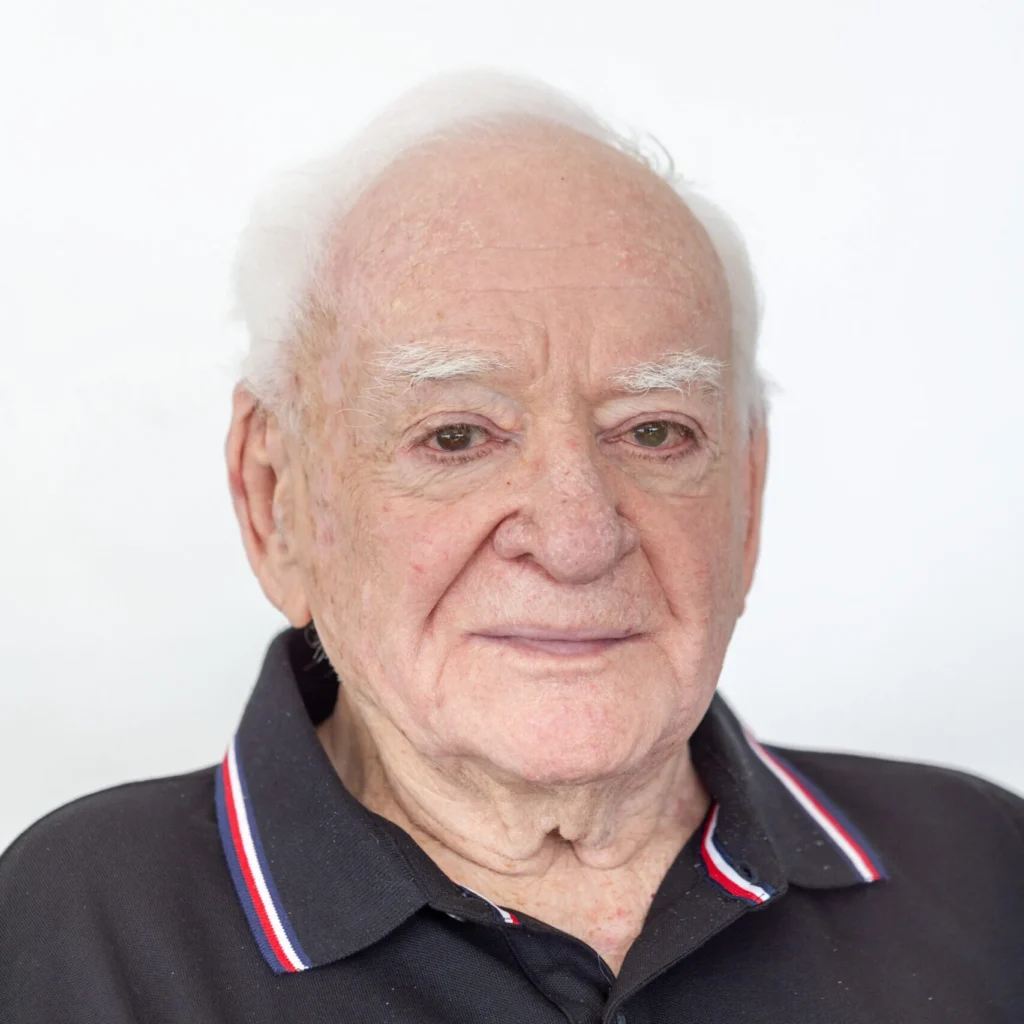
Second Torch: Monika Berzel, 88
Monika Berzel was born in 1937 in Berlin. Her father, Eugen, was a doctor, and her mother, Edith, was a surgical nurse. Eugen fled to England, and Edith worked long hours at the Jewish hospital in Berlin to support the family. Monika was raised mainly by her grandmother Gertrud. The three lived together in one room. Because of the wartime shortages, Monika’s strongest memories are of hunger and food.
In September 1942, Gertrud was deported to the Theresienstadt ghetto, where she was murdered. Monika then moved in with her mother at the hospital. Until liberation, she wandered the hospital without supervision—doctors, nurses, and patients were her only companions.
In February 1943, the Gestapo began rounding up Jewish forced laborers in Berlin for deportation to Auschwitz. In May, hospital director Walter Lustig was ordered to reduce his staff. He was forced to select 300 people for deportation. Monika was placed on a deportation train but was eventually told to get off.
Despite contracting diphtheria and other illnesses, she recovered without treatment. From 1944 onward, she spent many nights alone in bomb shelters during Allied air raids on Berlin. She remained in the hospital until the end of the war.
After the war, Edith and Monika moved to Sweden and then to London. Edith married Rudi Friedman, a Holocaust survivor from Berlin, who raised Monika as his own daughter.
Monika completed her dental studies in London and immigrated to Israel in 1962. She and her partner Ilan settled on Kibbutz Kfar Hanassi in the Upper Galilee. Monika worked as a dentist until the age of 70. Ilan passed away from cancer at age 59. Despite the emotional hardship, Monika continued working and volunteering.
Monika and the late Ilan have two children and six grandchildren.
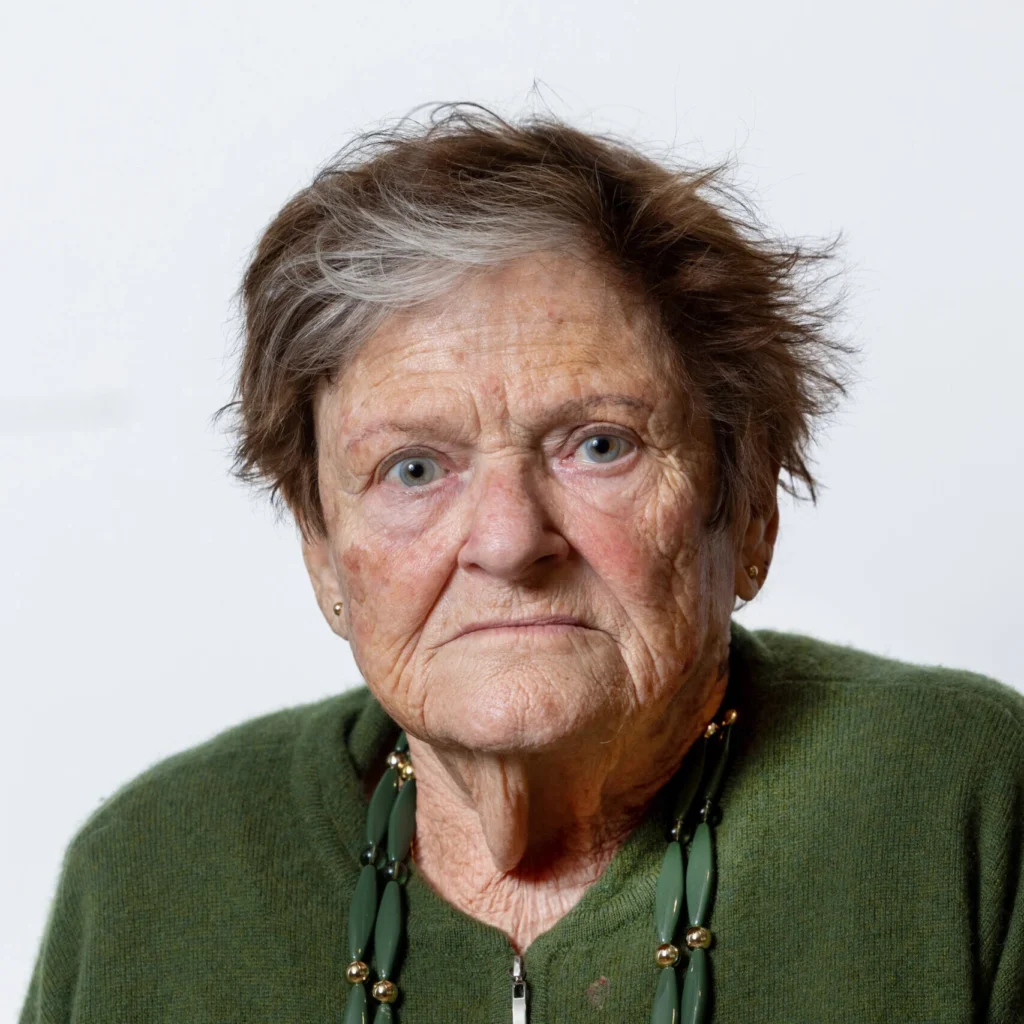
Third Torch: Felix Surin, 93
Felix Surin was born in 1932 in the city of Mogilev, Belarus. His father, Nathan, was a tailor and a committed communist. Still, the family spoke Yiddish at home and celebrated the Jewish holidays. In 1939, following the Soviet occupation of eastern Poland, Nathan was sent for work to the town of Oshmyany, and the rest of the family moved there as well.
After Nazi Germany invaded the Soviet Union in the summer of 1941, the family attempted to flee eastward. In the chaos, Felix became separated from his parents and was left alone in Nazi-occupied territory. A stranger warned him not to reveal that he was Jewish or that his father was a communist.
Felix wandered alone for a long time before arriving in Minsk, where he was imprisoned in the ghetto and witnessed the murder of Jews. He managed to escape but was caught and, pretending to be a Russian orphan, was placed in an orphanage. Several months later, suspicions arose that he was Jewish, and he was brought back to Minsk to face a Nazi investigation committee. Felix insisted he was not Jewish, and the fact that he was uncircumcised helped support his claim. One of the committee members, Vasily Orlov, backed his story. The committee secretary, who had previously known Felix, also chose not to expose him. Orlov was later recognized by Yad Vashem as one of the Righteous Among the Nations.
Felix was returned to the orphanage and kept his true identity hidden until the area was liberated by the Red Army in the summer of 1944.
After the war, he feared that none of his family had survived. Then he discovered that his father was alive and serving in the Red Army. Not long afterward, his older brother Yitzhak appeared unexpectedly at the orphanage and told him that their parents had managed to escape east and survive. Their mother, Frida, and older sister, Rosa, had survived deep within the Soviet Union. The family was reunited in Moldova.
Felix went on to study at the Polytechnic Institute in Odessa, where he became a lecturer and researcher. In 1992, he immigrated to Israel. He has remained active in Holocaust education, sharing his testimony with youth, students, and educators through Yad Vashem and various survivor organizations.
Felix and his late wife Ida had two children, five grandchildren, and five great-grandchildren.
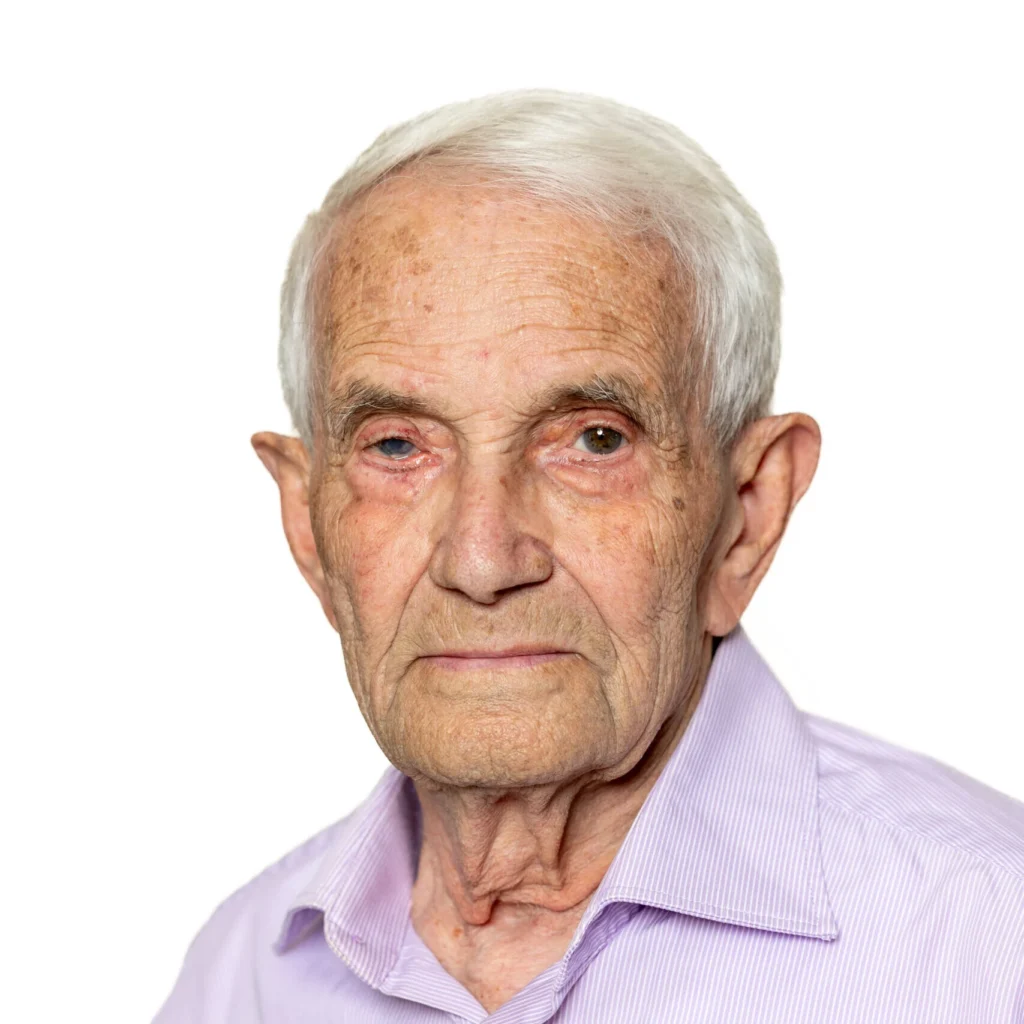
Fourth Torch: Rachel Katz, 88
Rachel Katz (née Laufman) was born in 1937 in Antwerp, Belgium, to a family of immigrants. She was the second of four children. Her parents, Feiga-Tzipora and Benjamin, had immigrated to Belgium from Bukovina, Romania. Feiga was a seamstress, and Benjamin was a merchant and glazier.
In May 1940, Nazi Germany invaded Belgium. In June 1942, Benjamin was arrested and sent to a labor camp in France. From there, he was transferred to the Mechelen transit camp in Belgium and deported to Auschwitz-Birkenau, where he was murdered in November 1942.
Feiga bore the burden of supporting and protecting her four young children. The family moved between hiding places. In one apartment, their neighbor, Maria Louben, provided forged identity papers and helped with shopping, as it was dangerous for the children to be seen outside. As German searches intensified, Louben took Rachel and her brother into her home, and later arranged for Rachel and two of her brothers to be hidden in a convent near Antwerp. Louben was later recognized as one of the Righteous Among the Nations for her efforts.
After several months, the children were removed from the convent due to a looming Gestapo raid. They returned to Antwerp and lived in a hidden apartment with their mother, using false identities. With the help of Belgian underground contacts, they remained there until Belgium was liberated in September 1944.
After the war, Rachel studied at the Tachkemoni Jewish school while working to help support her family. In 1957, she immigrated to Israel, married, and started a family.
In 2000, Rachel joined the Yesh Association for Holocaust survivor orphans and children, and today she serves as chair of Amcha, an organization supporting Holocaust survivors and second-generation descendants.
Rachel and her husband Shmuel have two children and three grandchildren.
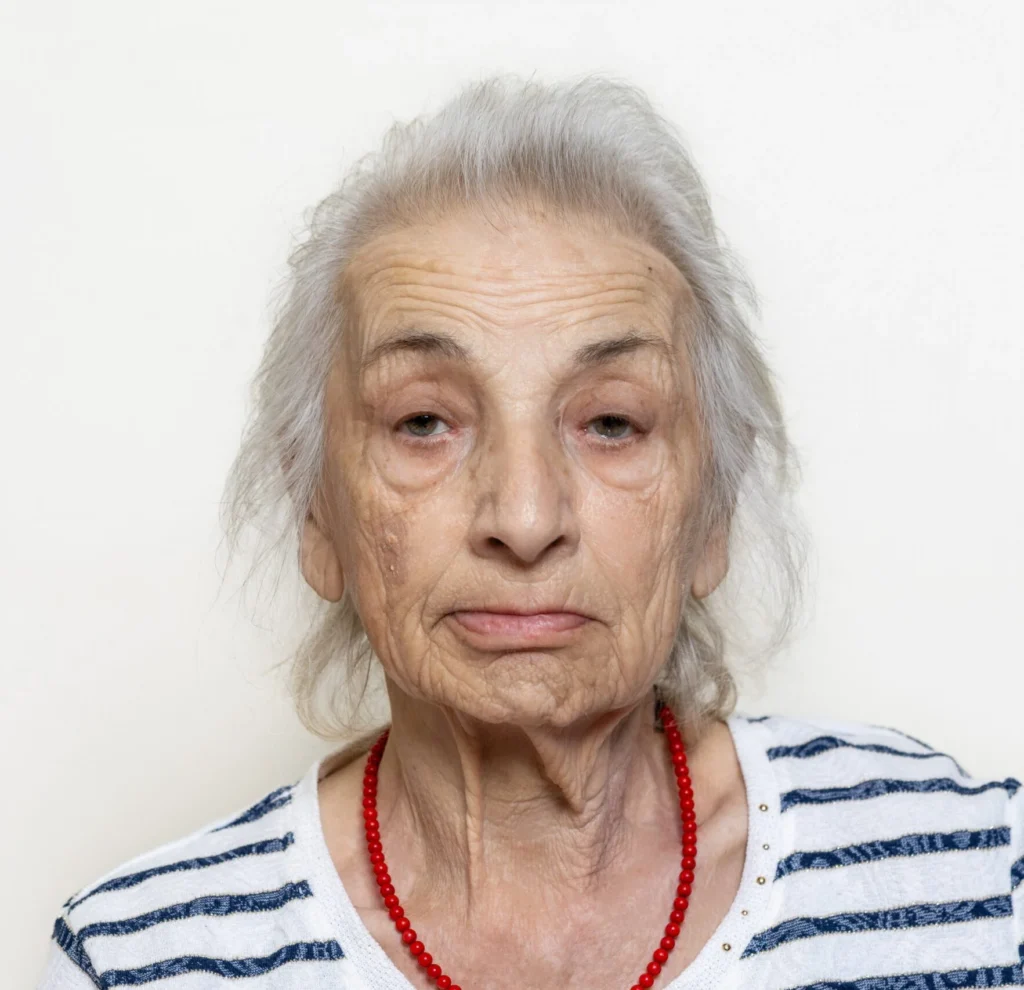
Fifth Torch: Aryeh Reiter, 96
Aryeh Reiter was born in 1929 in Vaslui, Romania, the eldest child in a devout Hasidic family. He studied at the Asa Tov Jewish school and in a Talmud Torah.
In 1939, the antisemitic Romanian regime closed the school he attended. His family was evicted and forced to live in a wooden shack. In 1941, his father Eliezer was sent to a Romanian forced labor camp and was murdered in 1943. Aryeh and his two younger brothers worked in stores to help support the family, suffering from extreme hunger.
In January 1944, Aryeh was deported with dozens of children to a labor camp near the town of Runc, where he helped build roads in the forest and construct a wooden bridge that still exists today. He slept on a wooden bunk in a barn and endured cold and starvation.
In August 1944, the Red Army liberated the area. Aryeh walked 80 kilometers barefoot under Soviet bombardment back to Vaslui. When he returned, he weighed just 30 kilograms. He reunited with surviving relatives, and the family lived in the basement of a relative’s home, as theirs had been destroyed.
Aryeh completed studies in commerce and economics. He joined the Bnei Akiva youth movement, led the local chapter, collected funds for the Jewish National Fund, and supported youth aliyah efforts. In 1947, he helped send his two brothers to Eretz Israel aboard the illegal immigration ship Pan York and continued to support the immigration movement. He immigrated himself in 1951 and reunited with his family in Beersheba.
Aryeh worked for the Ministry of Finance and Bank Mizrahi, eventually becoming the bank’s deputy director general. He earned bachelor’s and master’s degrees in Jewish history. He served in many public positions and established the Struma Museum and Beersheba’s “Struma” Great Synagogue, where he has served as gabbai (usher) for more than 60 years. In 2002, he was awarded the Yakir Beersheba honor for his public service.
Aryeh and his wife Yehudit have five children, as well as grandchildren and great-grandchildren.
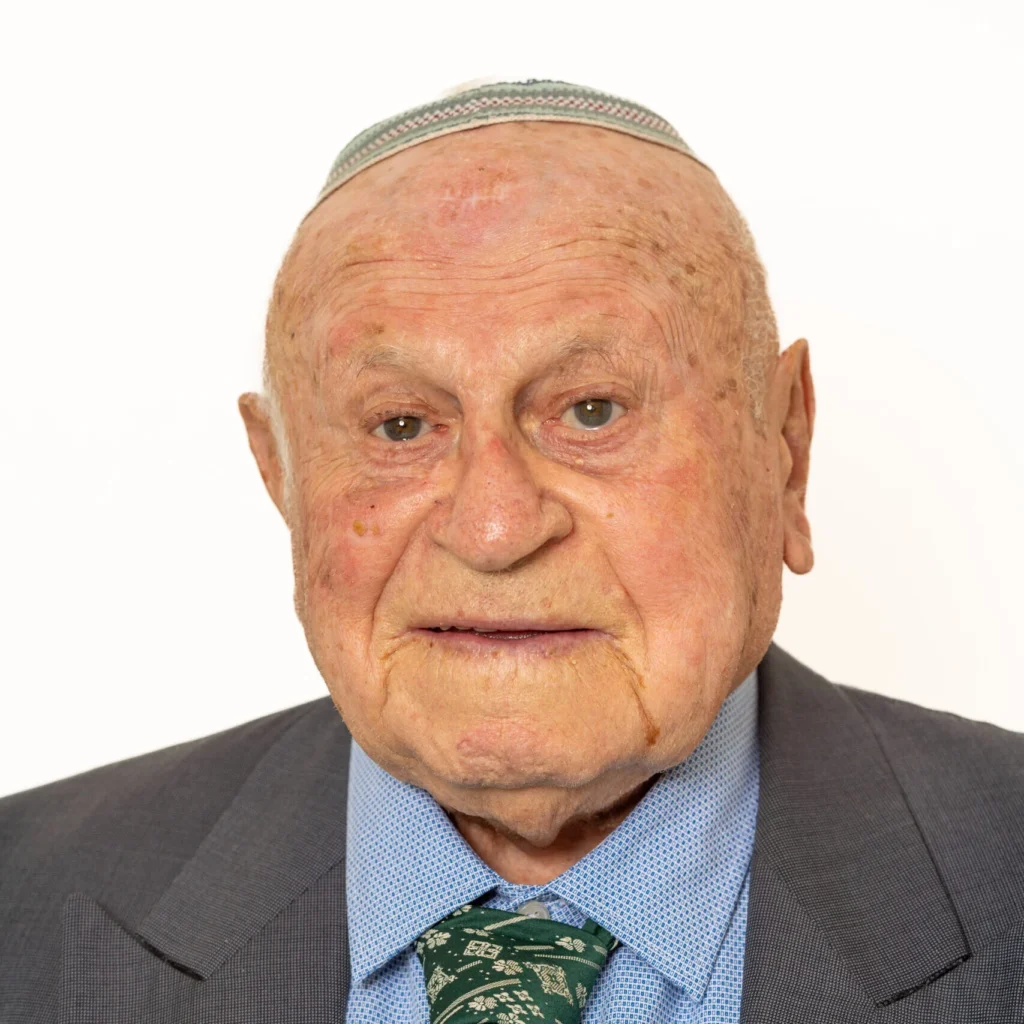
Sixth Torch: Gad Partok, 94
Gad Partok was born in 1931 in Nabeul, Tunisia, to a religious family with eleven children. His father Yosef was a fabric merchant, a member of the local Jewish community council, and a generous donor to the synagogue. Many of his clients were non-Jews. Jewish and Arab families in the city often celebrated holidays together.
In November 1942, Nazi Germany occupied Tunisia. One Friday evening, police knocked on the family’s door, and Yosef was summoned to the police station. As it was already Shabbat, he refused to travel by car and went on foot. He was detained for several hours. The next day, the family fled to the city of Hammam Lif and lived under false identities.
Gad’s mother, Oukaya, became ill and passed away. His father later remarried Marie, who became like a mother to the children. As the German presence in the city intensified, Yosef went into hiding. Marie sent Gad’s two brothers to hide in the forest. The rest of the family moved in with an uncle in Gabès, who had protected status through his job with the French Navy.
Eventually, the family’s money and jewelry, used for bribes during German searches, ran out. The family grew emaciated and constantly searched for food. Gad would go to the market dressed as an Arab child, even looking in garbage bins for food.
In May 1943, the Germans retreated from Tunisia. One day, a bearded man in unfamiliar clothing arrived at the house. Gad and his siblings didn’t recognize their own father at first.
The family reunited, returned to Nabeul, and celebrated Gad’s bar mitzvah. They later moved to Tunis, where Gad joined the Hashomer Hatzair youth movement.
In March 1948, Gad immigrated to Israel on an Italian fishing boat. He was received at Kibbutz Beit Zera and joined the Palmach. He later helped found Kibbutz Karmia, and eventually settled in Ashkelon. An amateur photographer, Gad turned his passion into a profession.
Gad and his late wife Mona had four children and thirteen grandchildren.
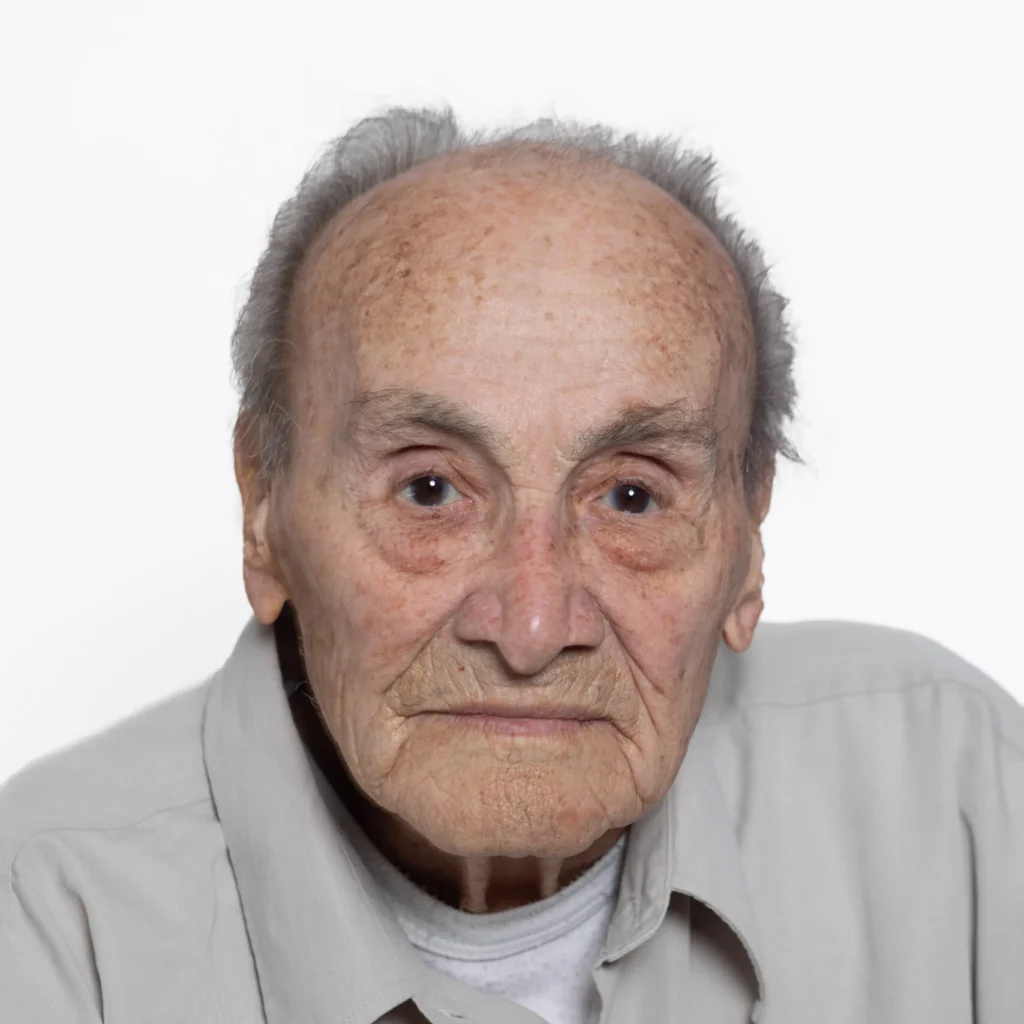
Speaker on Behalf of the Survivors: Eva Erban, 95
Eva Erban was born in 1930 in Děčín, Czechoslovakia. In 1935, her family moved to Prague. She studied ballet and played the piano.
After the German occupation in March 1939, the family’s home was confiscated and they were forced to move to a small apartment. Eva was banned from attending school and from entering shops, and had to wear a yellow star. Parents in the neighborhood organized home classes with a private tutor.
In December 1941, the family was deported to the Theresienstadt ghetto. At first, Eva and her mother lived in crowded shared quarters. Later, they joined her father in an attic space. Eva worked in a vegetable garden and occasionally smuggled food to her parents. She visited the elderly, sang for them, and performed in the children’s opera Brundibár.
In October 1944, her father was sent to Auschwitz. Soon after, Eva and her mother were deported as well. A fellow prisoner told Eva to say she was 18 to avoid the gas chambers. After three weeks, they were sent on a brutal journey to a forced labor camp in the Gross-Rosen complex. In January 1945, they were forced on a death march. Eva’s mother died in her arms and was buried in a mass grave.
One night, Eva fell asleep in the corner of a barn. When the Germans roused the prisoners the next morning, she remained sleeping and was left behind. Exhausted, she continued on foot toward the Czech border. A German soldier raised his weapon to shoot her, but another said it wasn’t worth wasting a bullet—she would die soon anyway.
Eva reached the village of Postřekov, where she collapsed. She awoke in a clean bed in the home of Ludmila and Kristof Jan, who cared for her lovingly until the war’s end. The couple was later recognized by Yad Vashem as Righteous Among the Nations.
Eva was placed in a Jewish orphanage in Prague, studied nursing, and worked in a hospital. At a party celebrating the founding of the State of Israel, she met Peter, another survivor of Theresienstadt. They immigrated to Israel in 1949. Eva shares her story in Israel and around the world.
Eva and the late Peter have three children, nine grandchildren, and fifteen great-grandchildren.
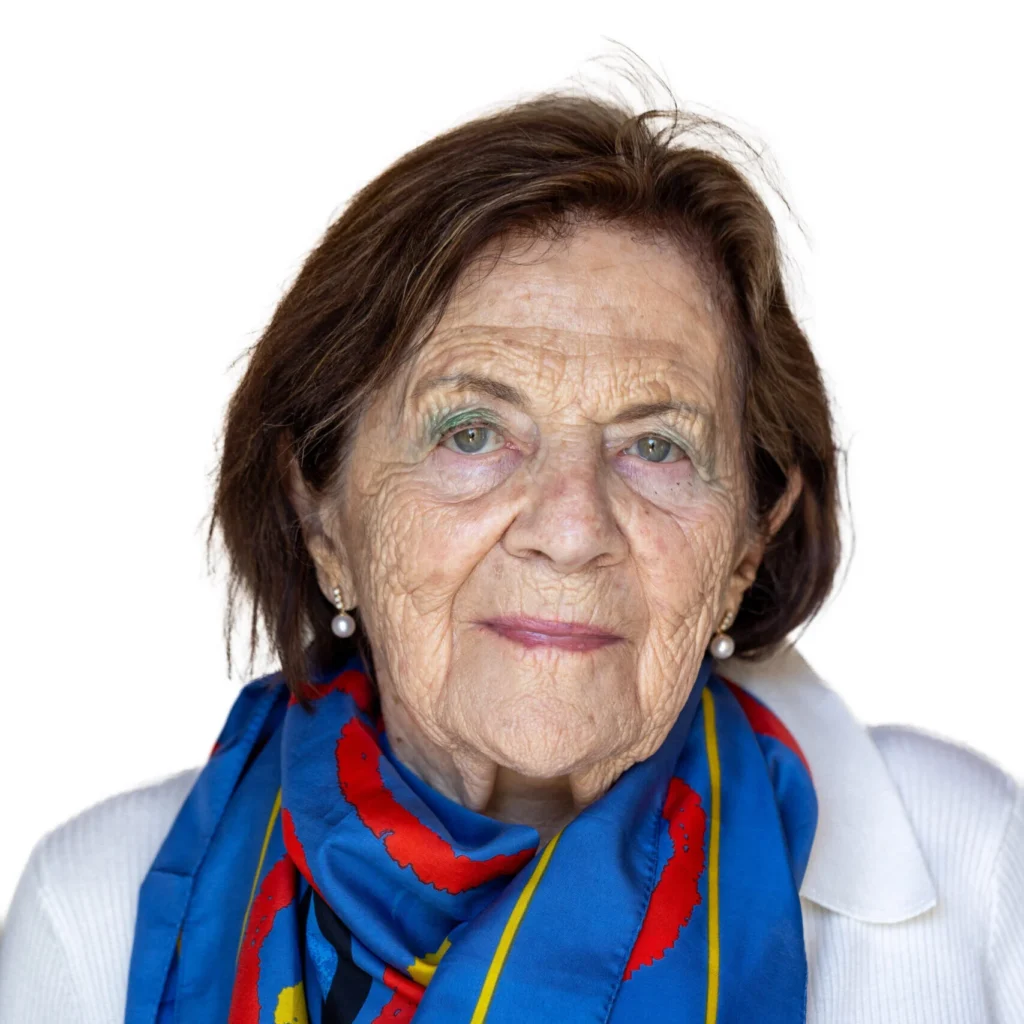
Reciter of the “El Maleh Rachamim” Prayer: Yehuda Hauptman, 87
Yehuda Hauptman was born in 1938 in Topoľčany, Czechoslovakia (now Slovakia). As the fascist Slovak regime allied with Nazi Germany, the situation for Jews worsened, and in 1941 the family moved to Budapest, Hungary.
In 1944, Nazi Germany invaded Hungary, and Yehuda was forced to wear a yellow star. His mother obtained Swedish citizenship papers for the family, and they took refuge in a protected house. His father was sent to a labor camp but escaped, hid in the forest, and returned—only to be captured again two weeks later and sent back to forced labor.
Yehuda’s grandparents were placed in a ghetto, where they helped his mother care for the four children. Due to starvation, Yehuda would leave the ghetto to search garbage bins for food scraps to bring home. In early 1945, the Soviets liberated Budapest, and Yehuda’s father returned from the labor camp.
After the war, Yehuda’s mother was diagnosed with tuberculosis and hospitalized. Under the Communist regime, children were required to attend school and write on Shabbat. His father decided to leave the country. In 1949, he arranged for Yehuda and his sister Rachel to be smuggled into Austria, paying guides to escort them. He remained behind with his ill wife, hoping to reunite with them later.
Yehuda and Rachel reached Vienna and joined a youth group organized by Naphtali Lau that aimed to immigrate to Israel. They passed through Italy and arrived in Israel in 1950. They were taken in by an uncle in Safed and later moved to a youth village in Petah Tikva. Their mother died in Budapest. Their father and two sisters eventually immigrated to Israel.
Yehuda joined Kibbutz Sha’alvim through Youth Aliyah, working in agriculture and studying. He served in the Nahal Brigade and fought in Israel’s wars. Yehuda and his wife Yehudit moved to Moshav Tkuma, where he fulfilled his dream of being a pioneering farmer. He held various public roles and contributed to the development and welfare of the region.
On October 7, 2023, Yehuda and Yehudit were at home in Moshav Tkuma, near the Gaza border. They were evacuated for four months. During that time, Yehuda deeply missed the land he loves. The separation strengthened his connection to the soil and his hope to return, overcome, and rebuild.
Yehuda and Yehudit have six children, twenty-three grandchildren, and ten great-grandchildren.