

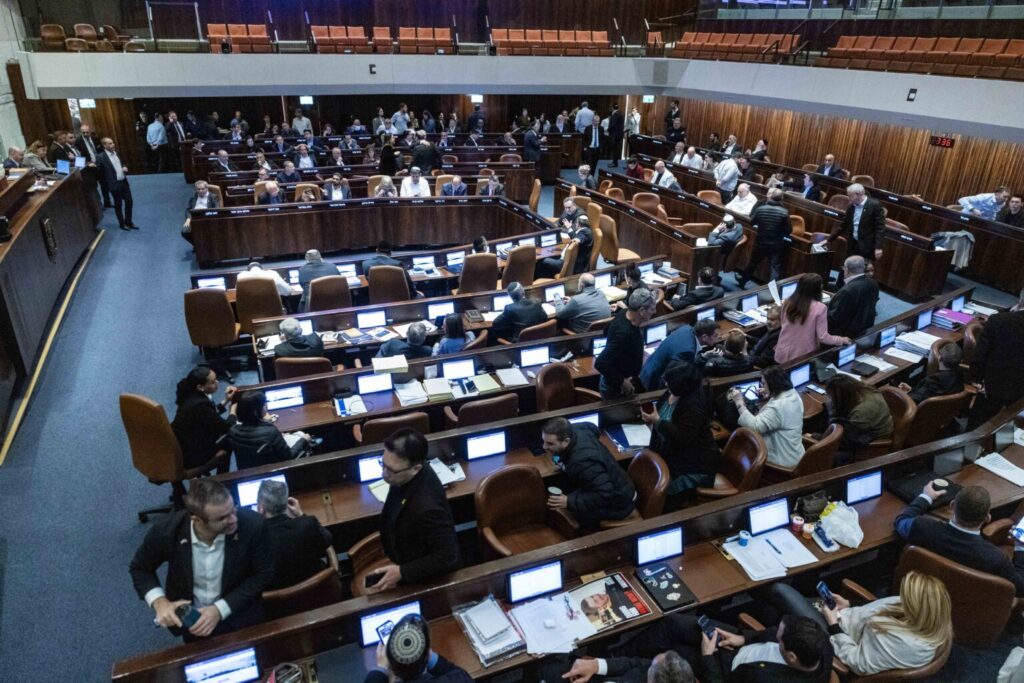
After 18 hours of debate, the Knesset this morning (Thursday) approved a controversial law that will change the makeup of the Judicial Appointments Committee, one of the most contested elements of the ongoing judicial reform. The bill passed with 67 votes in favor and only one against, as opposition lawmakers boycotted the vote.
What the Law Changes
This legislation enacts the Levin–Sa’ar framework, proposed by Justice Minister Yariv Levin and Foreign Minister Gideon Sa’ar. The new committee structure will only take effect in the next Knesset term, meaning a future government could overturn it on day one.
Current Committee Composition:
עוד באותו הנושא
3 Supreme Court justices (including the president)
2 representatives of the Israel Bar Association
Justice Minister (chair)
1 additional cabinet minister
2 Knesset members
Proposed Changes
Under the new law, the Bar Association representatives will be replaced by two professional legal experts, one appointed by the coalition, the other by the opposition. Judicial appointments will require cross-party consensus, involving the coalition, opposition, and judiciary.
Supreme Court justices on the committee will no longer have veto power over appointments to the High Court. A new mechanism will be introduced to prevent deadlock in appointments.
Additional reforms include:
Limiting the scope of Basic Laws and introducing a special legislative process to prevent hasty enactment. As a reminder, Israel does not have a formal constitution, the Basic Laws function as a de facto constitution, outlining the structure of government and protecting fundamental rights.
Judicial review of regular legislation will be limited to the Supreme Court, in a special panel with a defined majority.
A new Basic Law will be introduced to enshrine civil rights in criminal procedures, aimed at improving transparency and public trust in the legal system.
The Initiative Behind the Framework
Over the past three years, judicial reform proposals have sparked deep political and public divisions in Israel, with critics warning they threaten judicial independence and democratic checks and balances. Supporters argue the reforms are necessary to rebalance power between elected officials and an unelected judiciary.
The current proposal originated with former minister Izhar Shay and Brig. Gen. (res.) Dedi Simchi, both bereaved fathers, with the purpose of limiting tension and distrust within sectors of the public. They assert that their initiative was born out of a deep sense of national responsibility. “Israel is at a historic crossroads, fighting for its future in a painful and bloody war,” they said. “At such a time, we must all put the good of the country above all else.”
They thanked the Justice and Foreign Ministers for supporting the initiative and stated that the revised plan avoids a constitutional crisis while providing a solid foundation for judicial appointments.
“We aimed for broad consensus, one that would ensure the judiciary’s independence, professional excellence, and representation of all sectors of Israeli society.”