

For decades, the United States has relied on Israel as a key partner in the Middle East, a relationship that has withstood countless challenges and shifting administrations. This alliance, however, is more complex than it might seem. While Israel’s military and intelligence strength makes it a valuable ally, the U.S. also sees Israel as strategically useful when it is weaker, as it can then push Israel toward concessions in its peace process with the Palestinians and Arab nations. As the world watches the latest Gaza conflict unfold, questions linger: Will this relationship continue to thrive, and how might the election impact it?
The Birth of a Strategic Partnership
The roots of the U.S.-Israel “special relationship” go back to the early 1960s, when President John F. Kennedy spoke warmly of the two countries’ shared values. Yet, it was Israel’s 1967 victory in the Six-Day War that transformed this alliance into a serious strategic partnership. Israel’s military prowess became undeniable, and the U.S. saw Israel as a valuable regional ally who could help curb Soviet influence in the Arab world during the Cold War.
This shift signaled the beginning of a powerful alliance: Israel’s strength became an asset to the United States, serving as a democratic counterweight in a region fraught with instability. Since then, Israel’s intelligence-sharing and advanced military technology have been key to the U.S.’s strategic position in the Middle East. The United States has relied on Israel to help fight common threats, from Soviet-backed Arab states in the 20th century to modern-day Iranian proxies like Hezbollah and Hamas.
עוד באותו הנושא
- Israel Strengthens Global Alliances Amid Regional and International Challenges
- Hostages No More: IDF Returns Two Fallen Heroes from Gaza in Daring Operation
- Freed Hostage Turns Her Pain Into Strength at the UN Security Council
- On the 1st of Elul 1897, a National Return to the Land Joined the Spiritual Return to God
When Israel is strong, the U.S. reaps many benefits. Israel’s military and intelligence expertise not only enhance America’s regional standing but also give Washington a reliable partner in an area where alliances are often precarious. Former U.S. Ambassador to Israel Samuel Lewis once compared the U.S.-Israel relationship to a “Catholic marriage”—one that might face rough patches but would never truly break. This dynamic, however, becomes more complicated when Israel’s power wanes.
Israel’s Strength is America’s Strategic Gain
In moments when Israel has shown strength, the alliance has reached new heights. During the 1970 Jordanian Civil War, Israel proved just how valuable it could be. With Jordan’s King Hussein facing an uprising from Palestinian fighters backed by Syria, he turned to the U.S. for support. Occupied with the Vietnam War, the U.S. was unable to send direct military assistance. Instead, it turned to Israel, which mobilized forces to deter Syria from intervening further. By acting as America’s partner, Israel helped maintain regional stability, proving its role as a reliable U.S. ally in times of crisis.
This pattern repeated in later decades, with Israel acting as a counterbalance to destabilizing forces in the Middle East.
Throughout the 1980s, under President Ronald Reagan, the relationship hit new highs as the two countries aligned to contain Soviet-backed threats. Israel’s intelligence and military capabilities allowed the U.S. to keep a close watch on Soviet movements and maintain its influence in the region. Israel’s strength also became invaluable after the September 11 attacks, when the U.S. faced a new wave of global terrorism. From intelligence on terror networks to military insights, Israel became a critical ally in the U.S.’s War on Terror.
However, the U.S. stance has not always been to support Israel’s growth unchecked. When Israel’s strength threatens to destabilize negotiations with Arab states or the Palestinians, Washington has occasionally pulled back. This reflects a longstanding pattern in the relationship: when Israel is perceived as too powerful, the U.S. sometimes sees an opportunity to use its leverage to steer Israel toward concessions. While a strong Israel is a strategic asset, a weakened Israel is also useful as it allows the U.S. to exert greater control.
Israel’s Weaker Moments: When America Steps In
When Israel is in a weakened state, the U.S. has often used its influence to push for concessions in peace negotiations. During the Yom Kippur War in 1973, Israel was nearly overwhelmed by a surprise Arab coalition attack. The U.S. provided military support, ensuring Israel’s survival but withholding enough aid to prevent an outright victory. The U.S. goal was to maintain a balanced regional power, positioning itself as a mediator who could influence Israel to accept concessions.
This “hardware for software” strategy, in which the U.S. provides military aid in exchange for political concessions, has repeated over the decades. For example, during the Carter administration, the U.S. pressed Israel to make peace with Egypt and to engage in discussions about Palestinian autonomy. Again, during the Gulf War in 1991, the U.S. urged Israel not to respond to Iraqi missile attacks, a move that allowed the U.S. to maintain its coalition with Arab states. Although Israel complied, it demonstrated that the U.S. could effectively restrain Israel when it suited American interests.
When Israel faces existential threats, the U.S. provides crucial support, but when Israel is strong, the alliance tends to be mutually beneficial and cooperative. A weakened Israel, however, can serve U.S. diplomatic goals by being more amenable to Washington’s agenda, whether that means freezing settlements, returning land, or easing tensions with Palestinian leadership.
The Biden Administration and the Gaza Conflict
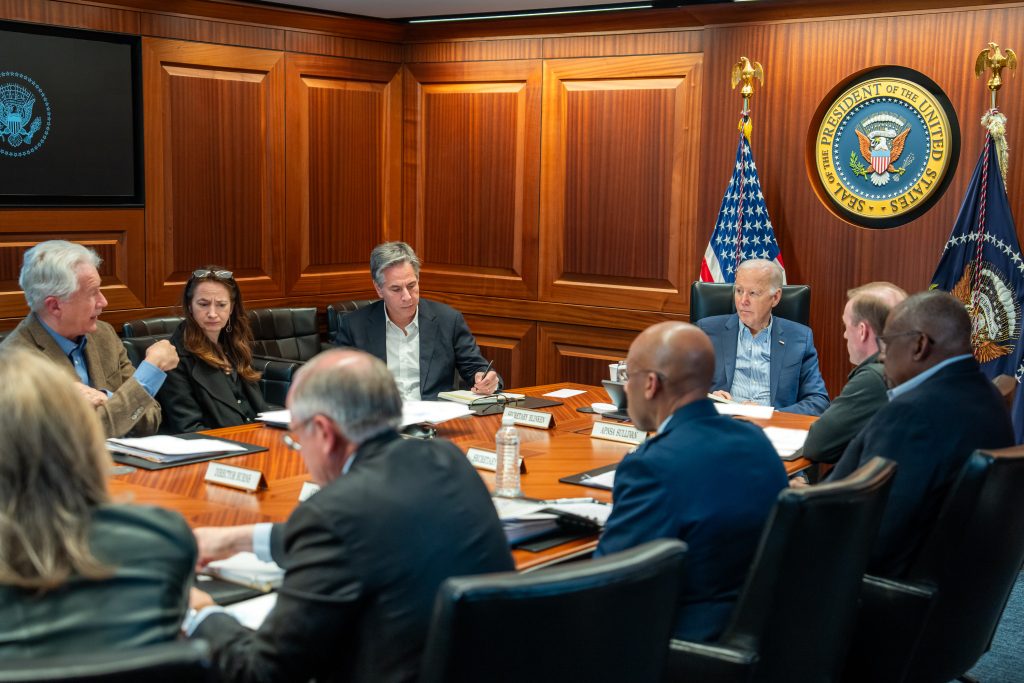
In today’s political landscape, the U.S.-Israel relationship is once again being tested. The Biden administration has expressed strong support for Israel following the October 7 Hamas attack, sending the USS Gerald R. Ford Carrier Strike Group to the region to deter further escalation. Yet Biden has also been clear that U.S. support does not come without conditions; his administration has urged Israel to show restraint in its Gaza operations to prevent wider regional instability.
This approach reflects the long-standing U.S. policy of leveraging aid to shape Israel’s actions, a tactic that dates back to the Cold War. Biden’s cautious stance, reminiscent of past leaders like Nixon and Carter, aims to keep Israel strong enough to defend itself and deter Iranian influence but restrained enough to avoid alienating Arab allies. The Biden administration’s decision to hold back on a UN Security Council resolution for a Gaza ceasefire until it secured assurances about hostages also highlights the complex balancing act of supporting Israel while managing broader regional interests.
As the conflict continues, Biden is likely to face pressure from both sides of the political aisle. Many Americans support Israel’s right to defend itself, but growing concern over civilian casualties in Gaza is stirring calls for the U.S. to demand more caution from its ally. While some progressive Democrats push for conditions on U.S. aid, the administration’s approach seems to follow a familiar script: support Israel’s security while quietly urging diplomatic concessions.
A Powerful Alliance, Regardless of Election Outcomes
The upcoming U.S. election adds another layer of complexity to the U.S.-Israel relationship. Democratic candidate Kamala Harris has indicated a more balanced approach, reportedly emphasizing Palestinian suffering in progressive regions while affirming Israel’s security to pro-Israel audiences. This approach underscores the delicate line that many American politicians must walk in a politically divided landscape. But experts believe that, regardless of the election outcome, the U.S.-Israel relationship is unlikely to weaken significantly.
The bond between the two nations is grounded in more than just shared values and democratic ideals. The U.S. sees Israel as a powerful ally that can help safeguard American interests in the Middle East, especially amid rising tensions with Iran. At the same time, the U.S. benefits from its ability to influence Israeli policy in moments of weakness, making the alliance valuable from both a strategic and diplomatic perspective.
The enduring strength of the U.S.-Israel relationship lies in this duality: Israel’s power boosts U.S. security in a volatile region, and when Israel’s strength is diminished, it opens the door for the U.S. to steer negotiations. This pragmatic approach ensures that the alliance will remain intact, no matter how it evolves.
What Lies Ahead for the US-Israel Relationship?
The US-Israel alliance has always been defined by a mix of mutual respect and strategic bargaining. When Israel is strong, it serves as a critical asset for the U.S., countering threats and providing valuable intelligence in a complex region. When Israel is weaker, Washington can leverage its influence to pressure Israel into making concessions that may advance American diplomatic objectives. This dynamic ensures that, even in moments of tension, the bond remains strong because both nations recognize the value of the partnership.
If former President Trump wins the election, it is likely that the US-Israel relationship will take a new turn to becoming the “very special relationship” it had become during the previous Trump adniminstration. Although there were some disagreements regarding the future of some communities of Judea and Samaria, otherwise, the Trump administration was very supportive of Israel with minimal restraint.
If Harris wins the 2024 election with a different stance on Middle Eastern diplomacy, the relationship might face new challenges. However, experts agree that America’s reliance on Israel as a strategic partner will likely outweigh any political disagreements. With the largest military and intelligence cooperation program of any U.S. ally and billions in annual military aid, Israel is more than just another partner for the U.S.; it’s an integral part of America’s Middle Eastern strategy.
As the Gaza conflict unfolds and Israel’s actions draw global scrutiny, some American politicians may urge a recalibration of the alliance. But the strategic significance of a strong Israel remains unassailable for most U.S. leaders. For both nations, this partnership is too valuable to abandon, and history shows that it can endure even as political climates shift. Regardless of the election outcome, the “special relationship” between the U.S. and Israel is likely to continue thriving—built on the understanding that Israel’s strength is America’s strength, and even in moments of weakness, Israel is a crucial ally for U.S. interests in the region.
Leah Bean Bowman is a licensed guide in Israel. She is has recently completed a MA in Political Science – Religion and Politics in the Middle East at Bar Ilan University.